Finspring

Fixed Deposit

Finspring’s FD SDK architecture
Fixed Deposit

A Technical Deep Dive into Finspring’s FD SDK Architecture

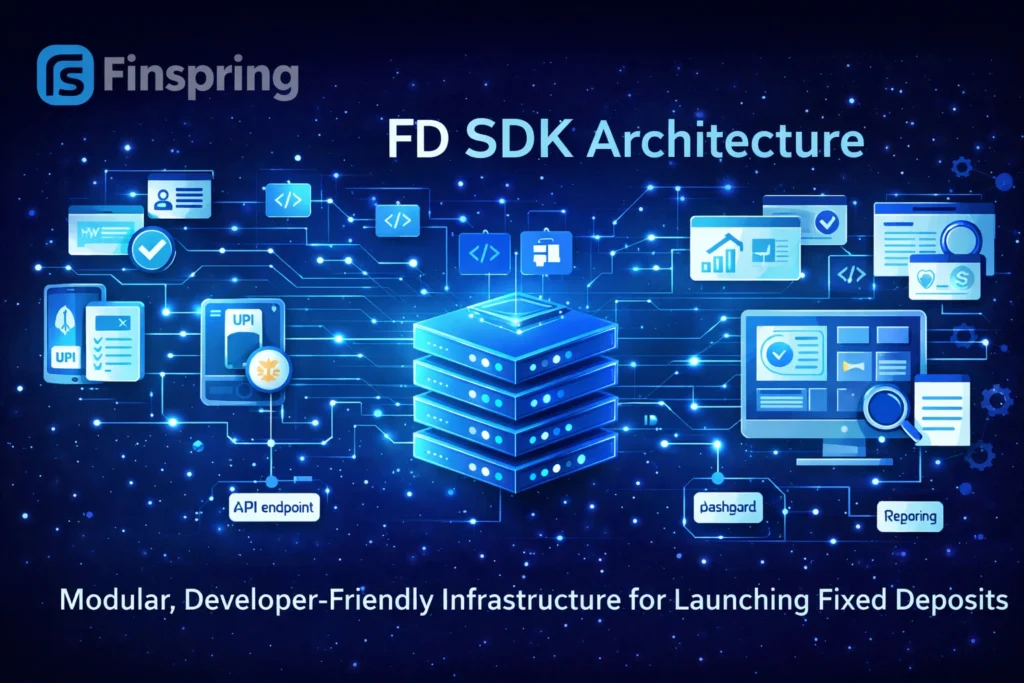
As financial institutions increasingly move toward digital-first product distribution, the ability to launch fixed deposit (FD) offerings through scalable technology has become essential. NBFCs, fintech platforms, wealth management apps, and digital banks are actively seeking infrastructure solutions that allow them to integrate FD products without building complex systems from scratch. This is where Finspring’s FD SDK architecture plays a critical role. Designed as a modular and developer-friendly infrastructure layer, the SDK allows financial platforms to seamlessly integrate fixed deposit products into their applications. Instead of building individual systems for onboarding, booking, reconciliation, reporting, and portfolio management, organizations can deploy Finspring’s architecture as a plug-and-play solution. Understanding the technical architecture behind the SDK provides valuable insight into how it delivers reliability, scalability, and security while significantly reducing implementation complexity. This article offers a deep dive into the FD SDK architecture powering Finspring’s platform. Why FD Infrastructure Requires Specialized Architecture Unlike many financial products, fixed deposits involve a long lifecycle with multiple operational checkpoints. From the moment a deposit is booked to its maturity and eventual payout, systems must track interest accruals, maintain accurate ledgers, handle renewals, and generate regulatory reports. A typical FD lifecycle includes several key stages: Customer onboarding and KYC verification Product discovery and rate selection Deposit booking and payment confirmation Deposit lifecycle management Interest calculation and maturity tracking Closure, renewal, or withdrawal Reporting and compliance monitoring Each of these stages requires reliable system coordination between multiple entities such as payment gateways, banking partners, compliance systems, and customer-facing applications. Finspring’s FD SDK architecture is designed specifically to manage these interactions while maintaining performance and operational transparency. Core Design Principles of Finspring’s FD SDK Architecture The architecture of the SDK is built around several guiding principles that ensure both technical efficiency and operational resilience. Modular Design The SDK follows a modular architecture that separates major system functions into independent components. Each module is responsible for a specific aspect of the FD lifecycle. Key modules include: onboarding and customer verification FD booking engine payment orchestration deposit lifecycle management portfolio and reporting services This modular structure allows institutions to integrate only the components they need while maintaining flexibility for future expansion. API-First Infrastructure Finspring’s platform follows an API-first architecture, meaning every system interaction is exposed through secure APIs. This approach ensures seamless integration with web platforms, mobile apps, internal dashboards, and partner ecosystems. Developers can interact with the SDK through clearly documented API endpoints for actions such as: retrieving available FD products creating deposit bookings tracking deposit status accessing maturity schedules managing customer portfolios An API-first design ensures that institutions can embed FD capabilities into existing digital products without disrupting their existing infrastructure. Event-Driven System Architecture To support real-time updates and system coordination, the FD SDK uses an event-driven architecture. This means that important actions within the system trigger events that automatically update other components. For example, when a deposit is successfully booked: A booking confirmation event is generated. The customer portfolio is updated. Transaction records are logged for reconciliation. Notification services can trigger alerts or confirmations. This event-driven workflow ensures that system components remain synchronized without relying on slow or inefficient polling mechanisms. Key Components of the FD SDK Architecture The SDK consists of multiple interconnected components designed to support the full deposit lifecycle. 1. Onboarding and Identity Layer The onboarding layer handles customer verification and identity management. This component integrates with KYC providers and identity verification systems to ensure compliance with financial regulations. Key capabilities include: customer identity verification document validation risk checks and compliance monitoring user account creation By integrating onboarding into the SDK architecture, financial institutions avoid building separate verification workflows for FD products. 2. FD Product Discovery Engine The product discovery engine allows platforms to display available FD offerings dynamically. This module retrieves real-time deposit information such as interest rates, tenure options, and minimum deposit amounts. Applications using the SDK can present these options within their user interfaces while maintaining synchronization with backend systems. This layer ensures that users always see the most accurate and up-to-date FD product information. 3. Deposit Booking Engine The deposit booking engine is the core transactional component of the FD SDK architecture. It manages the creation and confirmation of fixed deposits. Key responsibilities include: validating deposit parameters confirming payment completion generating deposit records initiating lifecycle tracking Once a deposit is booked, the system creates a unique deposit record that remains active throughout the lifecycle of the FD. 4. Payment Orchestration Layer Deposits require seamless coordination with multiple payment methods and financial systems. The payment orchestration layer manages interactions with payment rails such as UPI, net banking, or bank transfers. This component ensures that deposit bookings are confirmed only after successful payment completion. The payment layer also records transaction details for reconciliation and audit purposes. 5. Deposit Lifecycle Management System After a deposit is booked, it enters a lifecycle that may last several months or years. The lifecycle management system tracks the deposit from creation to maturity. Key functions include: interest calculation maturity tracking renewal workflows closure processing The system automatically updates deposit status and records lifecycle events to maintain accurate financial records. 6. Portfolio and Dashboard Services The portfolio management layer allows institutions and end users to monitor deposits in real time. This component aggregates deposit data into structured dashboards. Portfolio services support features such as: active FD summaries maturity timelines interest earnings deposit history These dashboards can be embedded into consumer apps, wealth management platforms, or administrative portals. 7. Reporting and Reconciliation Engine Financial systems require reliable reporting infrastructure for operational monitoring and regulatory compliance. Finspring’s architecture includes a dedicated reporting engine that generates: transaction logs reconciliation reports deposit activity summaries audit-ready records This module ensures transparency across all deposit operations and simplifies regulatory reporting requirements. Security and Compliance in the Architecture Security is a critical consideration in financial technology systems. Finspring’s FD SDK architecture incorporates multiple security layers to protect sensitive financial data. Key security mechanisms include: encrypted API communication role-based access controls secure authentication protocols transaction-level audit trails

end-to-end FD lifecycle management
Fixed Deposit

How Finspring Handles End-to-End FD Lifecycle Management

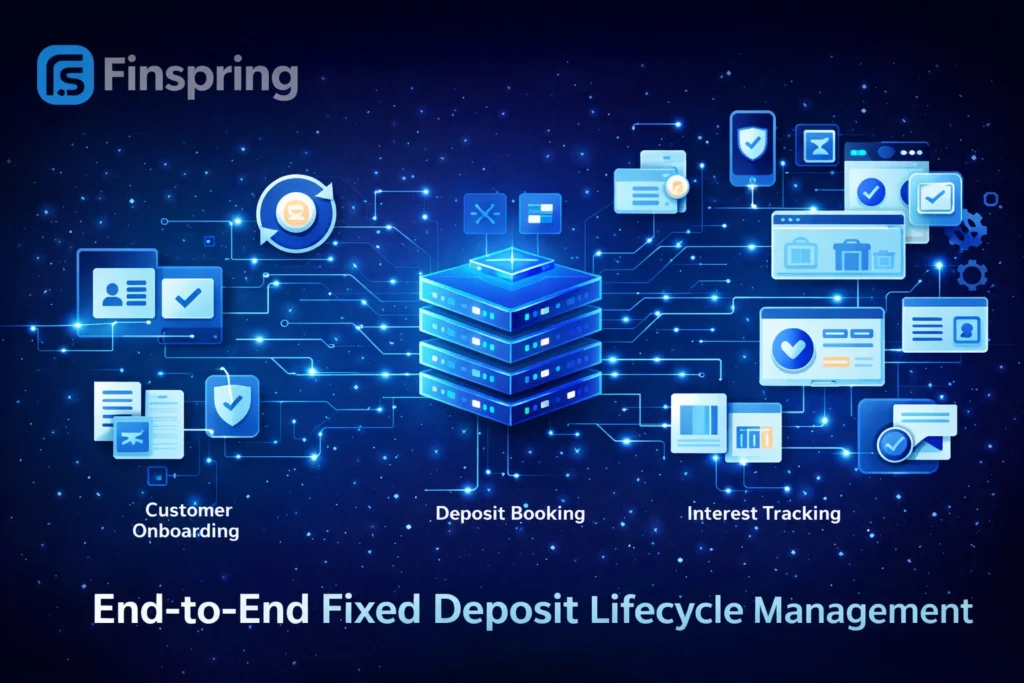
Fixed Deposits (FDs) remain one of the most trusted financial products in India’s savings ecosystem. For NBFCs, fintech platforms, and digital wealth providers, offering fixed deposits can help diversify funding sources, strengthen customer relationships, and improve product portfolios. However, launching and managing FD products involves much more than simply enabling users to make deposits. Financial institutions must manage the entire FD lifecycle, which includes customer onboarding, deposit booking, payment processing, interest tracking, maturity management, reporting, and regulatory compliance. Each stage requires accurate data handling, secure transactions, and seamless coordination between systems. Finspring simplifies this complexity by offering a comprehensive platform designed for end-to-end FD lifecycle management. Through its SDK-driven infrastructure, Finspring allows institutions to integrate and manage the full deposit journey—from the moment a user discovers an FD product to its maturity and final payout. This article explains how Finspring manages the entire FD lifecycle management process while ensuring operational efficiency, regulatory readiness, and a smooth customer experience. Understanding the Fixed Deposit Lifecycle Before exploring how Finspring manages deposits, it is important to understand the key stages involved in the lifecycle of a fixed deposit. A typical FD journey includes the following steps: Customer onboarding and identity verification Product discovery and deposit selection Deposit booking and payment confirmation Deposit lifecycle tracking and interest accrual Maturity management and payout processing Renewal or reinvestment options Reporting and compliance monitoring Each stage must function accurately and reliably because even small operational errors can impact financial records, regulatory compliance, and customer trust. Finspring’s infrastructure is designed to manage every step of this lifecycle automatically and securely. Stage 1: Customer Onboarding and Verification The first step in FD lifecycle management is ensuring that customers are verified and compliant with regulatory requirements. Financial institutions must conduct identity checks and KYC verification before allowing users to book deposits. Finspring integrates onboarding workflows into its platform, allowing institutions to manage customer verification seamlessly. Key onboarding capabilities include: identity verification and KYC integration document validation and compliance checks customer profile creation secure user authentication By integrating these processes into the platform, Finspring ensures that every deposit begins with a verified customer profile. This reduces fraud risks and helps institutions maintain regulatory compliance. Stage 2: FD Product Discovery Once onboarding is completed, customers must be able to discover available FD products easily. Product discovery plays a critical role in improving user engagement and conversion rates. Finspring enables financial platforms to present FD options dynamically within their applications. Users can view deposit offerings with details such as: interest rates deposit tenure options minimum investment requirements payout structures Because these product listings are powered through the SDK infrastructure, institutions can update FD offerings without rebuilding their application interfaces. This flexibility ensures that users always see accurate product information. Stage 3: Deposit Booking and Payment Processing After selecting an FD product, the customer proceeds to the deposit booking stage. This is one of the most critical parts of the FD lifecycle because it involves financial transactions and deposit record creation. Finspring manages this process through its deposit booking engine. Key functions include: validating deposit parameters processing payment confirmation generating deposit records initiating lifecycle tracking The platform also coordinates with payment systems to ensure that deposit bookings are confirmed only after successful payment completion. This eliminates discrepancies between payment transactions and deposit records. Once a deposit is successfully booked, it becomes part of the active FD portfolio managed by the system. Stage 4: Deposit Lifecycle Tracking After booking, the deposit enters its active lifecycle phase. During this period, the system must track interest accrual, maintain deposit records, and ensure accurate financial reporting. Finspring’s lifecycle management engine continuously monitors each deposit and records important events such as: interest accumulation tenure progression maturity date tracking account status updates These processes run automatically within the platform, reducing manual operational work for financial institutions. The lifecycle engine ensures that deposits remain accurately tracked from creation to maturity. Stage 5: Portfolio Monitoring and Customer Visibility Transparency is essential for maintaining customer trust in financial products. Users need to see their deposits clearly and track performance over time. Finspring provides portfolio management tools that allow users and institutions to monitor deposit activity. Key portfolio features include: active FD summaries maturity timelines interest earnings projections historical transaction records These dashboards can be embedded within mobile apps, wealth platforms, or financial dashboards. For institutions, the portfolio layer provides operational visibility into all deposits managed through the platform. Stage 6: Maturity and Payout Management As deposits approach maturity, the system must handle payout processing accurately. This stage involves calculating final interest earnings, updating financial records, and initiating payment transfers. Finspring’s maturity management engine automates these processes. Key functions include: calculating final payout values triggering maturity events initiating payout transactions updating deposit status Automation ensures that deposits are processed correctly without requiring manual intervention from operations teams. This capability becomes particularly valuable for institutions managing thousands of deposits simultaneously. Stage 7: Renewal and Reinvestment Options Many customers choose to reinvest their deposits after maturity. Offering seamless renewal options can help institutions retain deposit capital and maintain long-term customer relationships. Finspring supports renewal workflows within its FD lifecycle management system. Customers can choose to: renew their existing deposit for another tenure reinvest funds into new FD products withdraw funds at maturity These options can be presented through automated notifications or integrated user interface components. Providing reinvestment options directly within the platform improves user convenience and increases retention rates. Stage 8: Reporting, Reconciliation, and Compliance Financial institutions must maintain detailed records of deposit transactions to meet regulatory and operational requirements. Finspring includes a comprehensive reporting and reconciliation layer that ensures all FD activities are documented accurately. Reporting capabilities include: transaction logs deposit activity reports reconciliation summaries audit-ready records These records help institutions monitor financial operations and prepare regulatory submissions when required. By embedding reporting infrastructure into the lifecycle management system, Finspring reduces the administrative burden associated with deposit operations. Operational Benefits of End-to-End FD Lifecycle Management Managing the entire FD lifecycle through a unified platform

scale FD distribution
Fixed Deposit

Scaling FD Distribution Without Scaling Operational Risk

Fixed Deposits (FDs) continue to play a critical role in India’s financial ecosystem. For banks, NBFCs, and fintech platforms, FD products offer a reliable way to attract stable capital while providing customers with predictable returns and low-risk savings options. As digital finance grows, financial institutions are increasingly looking to scale FD distribution through online channels, partner ecosystems, and fintech marketplaces. However, expanding FD distribution is not simply a matter of reaching more customers. As distribution grows, operational complexity grows as well. Managing higher deposit volumes, more partner integrations, increased compliance requirements, and larger transaction flows can significantly increase operational risk. Without the right infrastructure, scaling FD distribution can create operational bottlenecks, data inconsistencies, compliance vulnerabilities, and customer experience issues. This is where infrastructure platforms like Finspring play a crucial role. By providing structured systems designed specifically for deposit operations, Finspring enables institutions to scale FD distribution while maintaining operational stability, regulatory compliance, and data accuracy. This article explores how financial institutions can expand FD distribution safely and how Finspring’s infrastructure helps manage the risks associated with scaling deposit operations. The Growing Opportunity in FD Distribution The shift toward digital finance has significantly expanded how fixed deposits are distributed. Historically, FD products were primarily sold through bank branches or direct institutional relationships. Today, however, deposit products are increasingly distributed through: fintech platforms wealth management apps digital banking platforms financial marketplaces investment advisory platforms This expansion allows financial institutions to reach new customer segments without relying solely on traditional distribution channels. For example, a fintech platform may offer deposits from multiple banks and NBFCs within a single app, allowing users to compare rates and invest easily. This approach dramatically increases the reach of FD products. However, expanding distribution channels introduces new operational challenges. Operational Risks in FD Distribution Expansion As financial institutions scale deposit distribution, several operational risks can emerge. Transaction Processing Complexity Higher deposit volumes increase the number of transactions that must be processed, validated, and recorded. Systems must ensure that every transaction is accurately linked to the corresponding deposit record. Data Synchronization Challenges When deposits are distributed across multiple digital platforms, data must remain synchronized between the distribution platform and the issuing financial institution. Any discrepancies in deposit records, payment confirmations, or maturity data can create operational problems. Compliance Monitoring Regulatory oversight becomes more complex as distribution networks expand. Institutions must ensure that all deposits meet compliance requirements, including KYC verification and reporting obligations. Reconciliation and Reporting As transaction volumes grow, financial institutions must maintain accurate reconciliation processes to track deposits, payouts, and maturity events. Manual reconciliation processes can quickly become inefficient at scale. Infrastructure as the Foundation for Scalable FD Distribution To scale FD distribution safely, institutions need infrastructure that can manage operational workflows efficiently. This infrastructure must support: automated transaction processing accurate deposit lifecycle tracking secure payment validation real-time data synchronization regulatory reporting and compliance monitoring Finspring provides this infrastructure through a unified platform designed to support high-volume deposit operations. By automating many operational processes, the platform reduces the risks typically associated with scaling deposit distribution. Automated Deposit Lifecycle Management One of the most important components of scalable FD distribution is lifecycle management. Every deposit must be tracked from the moment it is created until maturity and payout. This lifecycle may span months or years, requiring continuous monitoring of interest accrual, maturity dates, and status updates. Finspring’s infrastructure automatically manages deposit lifecycle events, including: deposit creation interest calculation tenure tracking maturity processing deposit closure or renewal Automation ensures that deposits remain accurately tracked even as transaction volumes increase. Real-Time Transaction Validation As FD distribution scales, ensuring the accuracy of transaction processing becomes critical. Finspring’s platform includes validation mechanisms that verify transactions before deposit records are created. Key validation steps include: verifying deposit parameters confirming payment completion creating secure deposit records logging transaction details These automated checks prevent discrepancies between payment systems and deposit records. By validating transactions in real time, the system minimizes operational errors that could otherwise increase as deposit volumes grow. Unified Data Synchronization Across Systems Digital FD distribution often involves multiple systems, including fintech platforms, banking partners, payment providers, and reporting tools. Maintaining consistent data across these systems is essential for operational reliability. Finspring ensures that deposit data remains synchronized across all connected systems. Important lifecycle events—such as deposit bookings, maturity updates, and payout confirmations—are automatically recorded and shared between systems. This synchronization ensures that all parties maintain consistent and accurate records. Integrated Compliance Monitoring Scaling deposit distribution increases the importance of regulatory compliance. Financial institutions must ensure that deposits distributed through digital channels meet regulatory requirements. Finspring embeds compliance monitoring into its infrastructure to support: customer verification workflows transaction monitoring audit trail maintenance regulatory reporting By integrating compliance logic into the platform, institutions can expand distribution channels while maintaining regulatory alignment. This reduces the risk of compliance failures as distribution networks grow. Scalable Infrastructure for High Deposit Volumes Financial platforms distributing FD products may experience sudden increases in deposit activity during promotional campaigns, market volatility, or seasonal investment cycles. Infrastructure must be capable of handling these surges without performance degradation. Finspring’s architecture is designed to support: high transaction throughput concurrent user activity large-scale deposit portfolio management Scalable infrastructure ensures that systems remain stable even during periods of rapid growth. Simplified Operational Oversight As deposit operations expand, financial institutions need clear visibility into their deposit portfolios and transaction activity. Finspring provides reporting dashboards that allow institutions to monitor key operational metrics. These dashboards include insights such as: total deposits under management deposit activity across platforms upcoming maturity schedules reconciliation reports Operational visibility helps institutions identify potential issues early and maintain control over large-scale deposit operations. Benefits of Scaling FD Distribution with Structured Infrastructure Using infrastructure designed for deposit management provides several strategic advantages. Reduced Operational Risk Automated workflows reduce the likelihood of errors in transaction processing and deposit tracking. Faster Distribution Expansion Institutions can onboard new distribution partners without building custom operational systems. Improved Compliance Management Embedded compliance monitoring helps institutions maintain regulatory alignment

Plug & Play FD SDK
Fixed Deposit

How Finspring’s Plug & Play FD SDK Reduces Time-to-Market by 70%

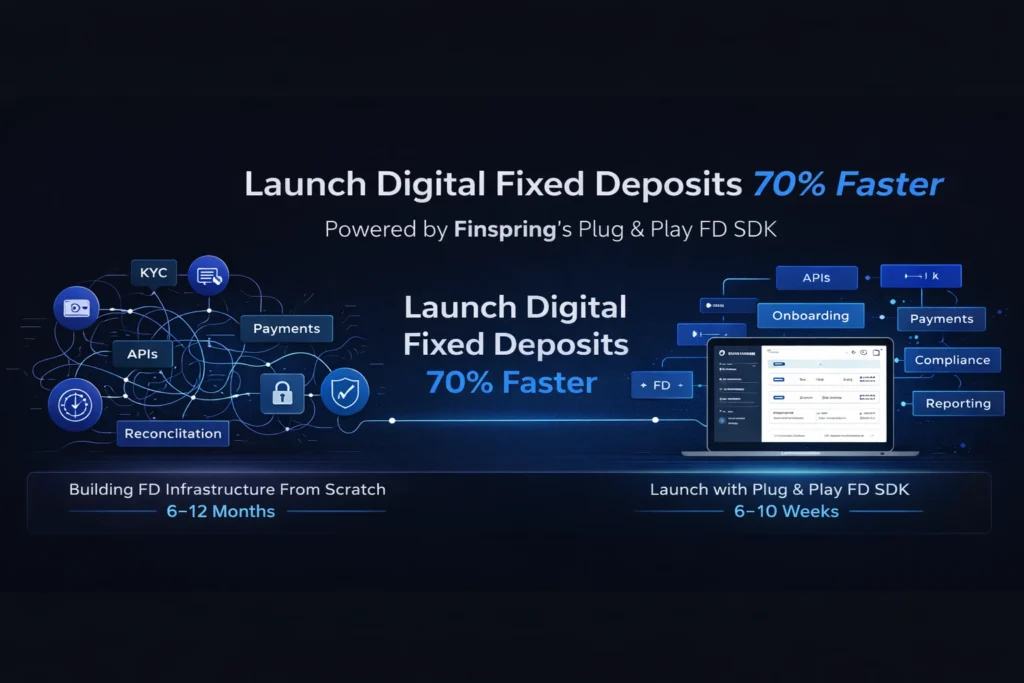
Launching Fixed Deposit (FD) products digitally has become a strategic priority for NBFCs, fintech platforms, and wealth management companies. Fixed deposits provide a stable funding source, strengthen customer trust, and enable institutions to diversify their financial offerings. However, building a fully functional digital FD infrastructure from scratch is complex, time-consuming, and operationally intensive. Institutions must develop multiple components including onboarding flows, KYC integrations, payment systems, reconciliation engines, reporting modules, compliance frameworks, and customer interfaces. Each of these layers involves regulatory considerations, security standards, and extensive testing. As a result, many financial institutions take 6–12 months or longer to launch a digital FD product. This is where Finspring’s Plug & Play FD SDK becomes transformative. By providing a ready-to-integrate software development kit designed specifically for FD distribution and management, Finspring enables institutions to reduce development complexity and launch FD products significantly faster. In many cases, organizations can reduce time-to-market by up to 70% compared to building an FD infrastructure internally. This article explains how the Plug & Play FD SDK accelerates FD launches while maintaining security, scalability, and regulatory compliance. Why Time-to-Market Matters for Digital FD Products In the financial services industry, speed of product deployment directly impacts competitive advantage. Institutions that launch new financial products faster can capture market demand earlier, attract new customers, and generate revenue sooner. However, delays in product development often arise due to multiple operational challenges. Common Barriers to Launching Digital FD Products Financial institutions frequently face the following challenges when building FD platforms internally: Complex technology architecture: Developing backend infrastructure for deposit lifecycle management. Regulatory compliance requirements: Ensuring adherence to RBI guidelines and audit requirements. Integration with payment systems: Supporting multiple payment rails such as UPI, net banking, and bank transfers. Customer onboarding flows: Implementing KYC, verification, and account creation processes. Operational monitoring: Building dashboards for reconciliation, reporting, and customer management. These elements must work seamlessly together before a product can go live. Coordinating multiple vendors, internal teams, and regulatory requirements significantly extends development timelines. A purpose-built FD SDK removes much of this friction. What Is a Plug & Play FD SDK? A Plug & Play FD SDK is a pre-built technology framework that allows financial institutions to integrate fixed deposit functionality directly into their digital platforms. Instead of developing FD infrastructure from scratch, developers can embed ready-made modules into their applications. The SDK typically includes APIs, UI components, documentation, and backend integrations necessary to support the entire FD lifecycle. Finspring’s FD SDK enables institutions to quickly integrate: FD product listing and discovery Customer onboarding and KYC Deposit booking workflows Payment processing Portfolio management dashboards Reporting and reconciliation tools Because these components are already designed, tested, and optimized, institutions can focus on integrating them into their existing platforms rather than building them from the ground up. How Finspring’s Plug & Play FD SDK Accelerates Time-to-Market Finspring’s architecture is specifically designed to simplify and streamline the process of launching digital FD products. Several key factors contribute to the dramatic reduction in time-to-market. 1. Pre-Built FD Infrastructure The most significant time savings come from eliminating the need to build deposit infrastructure internally. Finspring’s SDK provides ready-made modules for: FD booking workflows interest calculation maturity tracking customer portfolio management renewal and closure processes These components are already optimized for performance and reliability. As a result, development teams do not need to spend months designing the underlying system architecture. Instead, they can simply integrate the SDK into their application environment and configure it according to their product requirements. 2. Simplified API Integrations Integrating multiple financial services APIs is typically one of the most time-consuming parts of building a fintech product. Finspring’s SDK simplifies this process by offering unified APIs that manage key interactions across the FD lifecycle. Developers can integrate these APIs into web platforms, mobile apps, or internal dashboards without complex engineering overhead. For example, APIs support functions such as: creating FD bookings retrieving deposit details tracking maturity timelines updating customer portfolios Because these APIs are standardized and documented, development teams can implement them quickly and confidently. 3. Built-In Compliance and Reporting Compliance requirements are a major reason why financial product launches are delayed. Financial institutions must ensure that their systems support regulatory reporting, audit trails, and accurate record-keeping. Finspring’s FD SDK includes built-in capabilities for: transaction logs reconciliation records regulatory reporting formats audit-ready documentation These features allow institutions to launch FD products while maintaining operational transparency and regulatory readiness. By embedding compliance infrastructure within the SDK, Finspring removes the need for institutions to build separate reporting and monitoring systems. 4. Scalable Infrastructure from Day One When financial products gain traction, systems must be capable of handling increased user activity and deposit volumes. Building scalable infrastructure internally requires careful planning and testing. Finspring’s SDK is designed to support high transaction volumes and rapid user growth. The infrastructure is optimized for performance during periods of high FD inflows. This scalability ensures that institutions can launch quickly without worrying about rebuilding their systems later as demand increases. 5. Reduced Development and Testing Cycles Traditional fintech product launches involve multiple stages of development, testing, debugging, and iteration. Each component must be validated individually before being integrated into the full system. Because Finspring’s SDK is pre-tested and production-ready, development teams can dramatically shorten their testing cycles. Instead of validating every backend component individually, teams primarily focus on: integration testing UI customization workflow optimization This streamlined process significantly accelerates the journey from development to production deployment. Comparing Traditional Development vs SDK-Based Deployment The difference in launch timelines becomes clear when comparing the two approaches. Development Approach Typical Launch Timeline Complexity Building FD infrastructure internally 6–12 months Very High Integrating Finspring Plug & Play FD SDK 6–10 weeks Moderate By reducing infrastructure development, compliance setup, and testing requirements, the SDK can shorten the product launch timeline by approximately 70%. This speed advantage allows institutions to respond quickly to market opportunities and evolving customer demand. Strategic Benefits Beyond Faster Launches While faster time-to-market is the primary advantage, Finspring’s SDK also provides several long-term strategic

compliance-first FD infrastructure
Fixed Deposit

Compliance-First FD Infrastructure: How Finspring Embeds Regulatory Logic

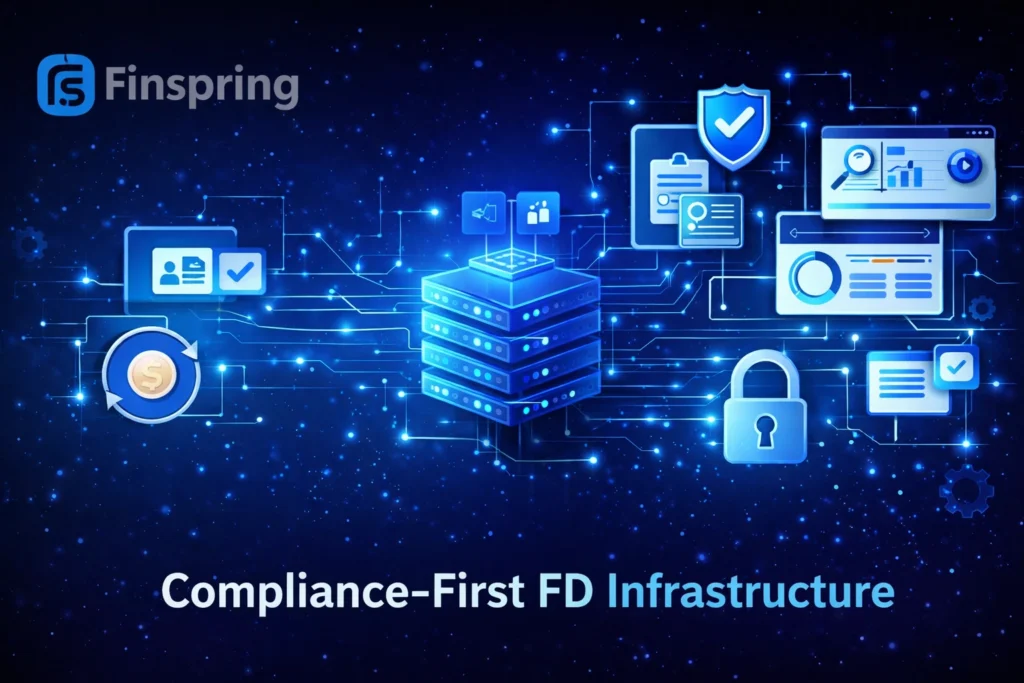
In financial services, compliance is not an optional feature—it is the foundation of trust, operational stability, and regulatory approval. For institutions offering fixed deposit (FD) products, compliance requirements extend across every stage of the deposit lifecycle. From onboarding and transaction monitoring to reporting and audit trails, financial institutions must maintain strict adherence to regulatory guidelines. For NBFCs, fintech platforms, and digital wealth providers, building this infrastructure internally can be extremely complex. Regulatory frameworks evolve frequently, and ensuring that technology systems consistently meet compliance requirements requires extensive expertise, monitoring, and engineering effort. Finspring addresses this challenge through a compliance-first FD infrastructure that embeds regulatory logic directly into its platform architecture. Instead of treating compliance as an external process layered on top of financial systems, Finspring integrates compliance checks and reporting mechanisms into the core infrastructure powering FD products. This article explores how Finspring’s compliance-first FD infrastructure ensures regulatory alignment while enabling institutions to launch and manage FD products efficiently. Why Compliance is Critical for Fixed Deposit Infrastructure Fixed deposits represent a regulated financial product that requires strict operational oversight. Financial institutions managing deposit products must comply with regulatory guidelines that govern customer verification, deposit recordkeeping, financial reporting, and risk management. These compliance obligations typically include: Know Your Customer (KYC) verification Anti-Money Laundering (AML) monitoring transaction recordkeeping and reporting deposit lifecycle tracking audit trail maintenance regulatory disclosures Failure to comply with these requirements can lead to financial penalties, reputational damage, and regulatory action. As financial services increasingly shift to digital platforms, the technology supporting deposit products must be designed with compliance at its core. The Concept of Compliance-First Infrastructure Traditional financial systems often treat compliance as a separate operational layer. Institutions may build their core financial systems first and then add compliance monitoring through external tools or manual workflows. This approach introduces several risks: delayed detection of regulatory issues fragmented reporting systems operational inefficiencies increased compliance costs A compliance-first FD infrastructure reverses this model. Instead of adding compliance later, regulatory logic is embedded directly into the system architecture. Finspring follows this approach by integrating compliance mechanisms into every stage of the FD lifecycle. Compliance Built Into the FD Lifecycle Finspring’s infrastructure ensures that regulatory requirements are enforced throughout the deposit lifecycle. 1. Compliant Customer Onboarding The first step in regulatory compliance begins with customer onboarding. Financial institutions must verify customer identities and ensure that users meet regulatory standards before allowing them to access financial products. Finspring integrates onboarding workflows that support: identity verification processes KYC documentation validation risk screening and verification checks secure customer profile creation By embedding these checks into the platform, Finspring ensures that only verified users can book deposits. This reduces the risk of fraudulent activity and ensures regulatory compliance from the start of the deposit journey. 2. Transaction Monitoring and Deposit Validation Every deposit transaction must be validated and recorded accurately. Financial institutions are required to maintain clear records of deposit transactions for both operational and regulatory purposes. Finspring’s platform manages deposit validation through automated transaction workflows. Key compliance functions include: deposit parameter validation payment confirmation checks transaction logging deposit record creation These automated checks ensure that deposits are processed according to defined operational rules while maintaining accurate records for reporting. 3. Automated Deposit Lifecycle Tracking Regulators often require financial institutions to maintain detailed records of deposit activity throughout the lifecycle of each deposit. Finspring’s infrastructure automatically tracks important lifecycle events, including: deposit creation interest accrual tenure progression maturity events deposit closure Each event is recorded within the system, creating a complete lifecycle history for every deposit. This automated tracking ensures that institutions can easily retrieve deposit data when required for audits or regulatory reviews. 4. Built-In Audit Trails Audit trails are essential for financial accountability. Regulators require institutions to maintain clear records of all system activities and financial transactions. Finspring embeds audit trail functionality directly into its platform. Key audit capabilities include: system activity logging transaction history tracking user interaction records timestamped operational events These records provide a transparent view of how deposits are processed and managed within the system. Audit trails help institutions demonstrate compliance during internal reviews, external audits, or regulatory inspections. 5. Reconciliation and Financial Reporting Accurate financial reconciliation is another critical compliance requirement. Institutions must ensure that deposit transactions, payments, and financial records remain synchronized. Finspring provides built-in reconciliation systems that generate reports for operational monitoring. Reporting capabilities include: transaction reconciliation reports deposit activity summaries payout records financial ledger alignment These reports help institutions verify the accuracy of their financial data while maintaining compliance with reporting standards. Security as a Compliance Foundation Compliance and security are closely interconnected in financial systems. Protecting customer data and transaction records is essential for regulatory adherence. Finspring’s compliance-first infrastructure incorporates several security layers designed to protect sensitive financial information. Security measures include: encrypted data transmission secure authentication protocols role-based access controls data protection mechanisms These safeguards ensure that deposit records and customer information remain secure while meeting regulatory expectations for data protection. Regulatory Readiness Through System Architecture One of the most valuable aspects of Finspring’s infrastructure is its ability to support regulatory readiness from day one. Because compliance logic is embedded directly into the system architecture, financial institutions do not need to design separate compliance frameworks when launching FD products. This architecture enables institutions to: launch FD offerings faster maintain consistent compliance standards simplify regulatory reporting processes reduce operational risk By automating compliance workflows, Finspring reduces the burden on internal compliance teams while maintaining regulatory alignment. Benefits of a Compliance-First FD Infrastructure Adopting a compliance-first infrastructure offers several strategic advantages for financial institutions. Reduced Regulatory Risk Embedding compliance logic directly into the platform reduces the likelihood of regulatory violations. Operational Efficiency Automated compliance workflows eliminate many manual processes associated with reporting and monitoring. Faster Product Deployment Institutions can launch FD products without building extensive compliance systems from scratch. Improved Transparency Comprehensive audit trails and reporting tools provide clear visibility into deposit operations. The Growing Importance of Embedded Compliance As financial ecosystems become more digital and interconnected,

multi-partner FD enablement
Fixed Deposit

Multi-Partner FD Enablement: How Finspring Manages Product Diversity

As digital financial ecosystems evolve, customers increasingly expect access to a wide variety of financial products within a single platform. Fixed Deposits (FDs), traditionally offered through individual banks or NBFCs, are now being distributed through fintech apps, wealth platforms, and digital marketplaces that aggregate products from multiple financial institutions. This shift has created a new infrastructure challenge. Digital platforms want to offer FD products from multiple banks and NBFCs, but managing different deposit products, interest structures, tenures, and operational workflows across multiple partners can quickly become complex. Finspring addresses this challenge through its multi-partner FD enablement infrastructure. By providing a standardized platform that connects multiple financial institutions and distribution platforms, Finspring enables digital ecosystems to manage diverse FD products efficiently. This article explores how Finspring supports multi-partner FD enablement, allowing financial platforms to offer a broad range of FD products while maintaining operational simplicity, regulatory alignment, and a seamless user experience. The Rise of Multi-Institution FD Marketplaces Historically, fixed deposits were distributed directly by the issuing institution. Customers typically opened deposits through a specific bank branch or through that bank’s digital interface. Today, the financial landscape is shifting toward aggregated financial marketplaces. Fintech platforms and wealth apps increasingly provide access to deposit products from multiple institutions. This approach offers several benefits for both platforms and users. Benefits for Digital Platforms Access to a wider range of deposit products Increased customer engagement through product choice Improved competitiveness with diversified offerings Higher transaction volumes and distribution potential Benefits for Customers Ability to compare interest rates across institutions Greater flexibility in choosing deposit tenures Access to multiple trusted financial institutions within a single app However, managing FD products from multiple partners introduces operational complexity that requires specialized infrastructure. The Challenge of Product Diversity in FD Distribution Each bank or NBFC offering fixed deposits may structure their products differently. These variations create challenges for digital platforms attempting to aggregate FD products. Common differences across institutions include: interest rate structures tenure options minimum deposit requirements payout schedules renewal policies operational workflows Without a standardized framework, integrating these variations can lead to complicated engineering work and inconsistent user experiences. This is where multi-partner FD enablement infrastructure becomes critical. Finspring’s Approach to Multi-Partner FD Enablement Finspring’s platform is designed to simplify the management of FD products across multiple financial institutions. Instead of requiring platforms to build separate integrations for each partner, Finspring provides a unified infrastructure layer that standardizes how FD products are discovered, booked, and managed. Through this approach, digital platforms can access multiple deposit providers through a single integration. This dramatically reduces the complexity associated with managing product diversity across financial institutions. Standardized Product Framework One of the most important components of Finspring’s infrastructure is its standardized product framework. Although different banks and NBFCs structure their FD products differently, Finspring converts these variations into a standardized data structure. This structure organizes deposit attributes such as: interest rates tenure durations investment thresholds payout schedules maturity details By normalizing product information, Finspring allows digital platforms to present FD products in a consistent format. This standardization improves both developer efficiency and user experience. Dynamic Product Discovery Product discovery plays an important role in helping users explore available FD options across institutions. Finspring enables digital platforms to retrieve available FD offerings dynamically through APIs. This allows platforms to display multiple deposit products in real time. Users can compare FD options across institutions based on key factors such as: interest rates tenure length payout type investment requirements Dynamic product discovery ensures that users always see the most accurate and up-to-date deposit offerings available through the platform. Unified Deposit Booking Workflow One of the biggest challenges in multi-partner FD distribution is managing the booking process across different institutions. Each bank or NBFC may have unique operational workflows for deposit creation and confirmation. Finspring solves this problem by providing a unified booking workflow that standardizes deposit transactions across partners. The booking workflow includes: validating deposit parameters confirming payment completion creating deposit records synchronizing data with partner institutions This standardized process allows platforms to manage deposits across multiple partners without implementing separate booking systems. Lifecycle Management Across Multiple Institutions After a deposit is booked, the system must track its lifecycle from creation to maturity. When FD products come from multiple institutions, lifecycle management becomes even more complex. Finspring’s infrastructure manages lifecycle events consistently across all partner institutions. Lifecycle tracking includes: deposit creation interest accrual tenure progression maturity tracking payout processing By centralizing lifecycle management, Finspring ensures that deposit data remains consistent across platforms and partner institutions. Managing Product Updates and Rate Changes Interest rates and deposit product parameters often change based on market conditions or institutional policies. Without centralized infrastructure, updating these changes across multiple platforms can become difficult. Finspring’s system enables financial institutions to update product attributes directly within the platform. These updates are automatically reflected across connected distribution platforms, ensuring that users always see accurate deposit offerings. This capability simplifies product management while reducing operational overhead. Compliance Across Multiple Partners Regulatory compliance becomes more complex when deposits are distributed across multiple financial institutions. Each partner institution must ensure that deposit transactions meet compliance standards related to customer verification, transaction monitoring, and reporting. Finspring embeds compliance mechanisms into its infrastructure to ensure that deposits distributed through the platform meet regulatory requirements. These mechanisms include: onboarding verification workflows transaction monitoring audit trail logging reporting infrastructure By integrating compliance checks into the platform, Finspring ensures that multi-partner deposit distribution remains aligned with regulatory expectations. Operational Visibility for Distribution Platforms Managing FD products from multiple partners requires strong operational oversight. Finspring provides reporting dashboards that give platforms visibility into their deposit operations. These dashboards provide insights such as: deposits booked across institutions distribution performance by partner upcoming maturity schedules portfolio summaries Operational visibility allows platforms to manage large-scale deposit distribution effectively. Strategic Benefits of Multi-Partner FD Enablement Finspring’s infrastructure enables digital platforms to manage diverse deposit offerings while maintaining operational efficiency. Key benefits include: Expanded Product Offerings Platforms can offer FD products from multiple

NBFC Funding
Fixed Deposit

How Can NBFCs Diversify Funding Sources by Launching Fixed Deposit Products?

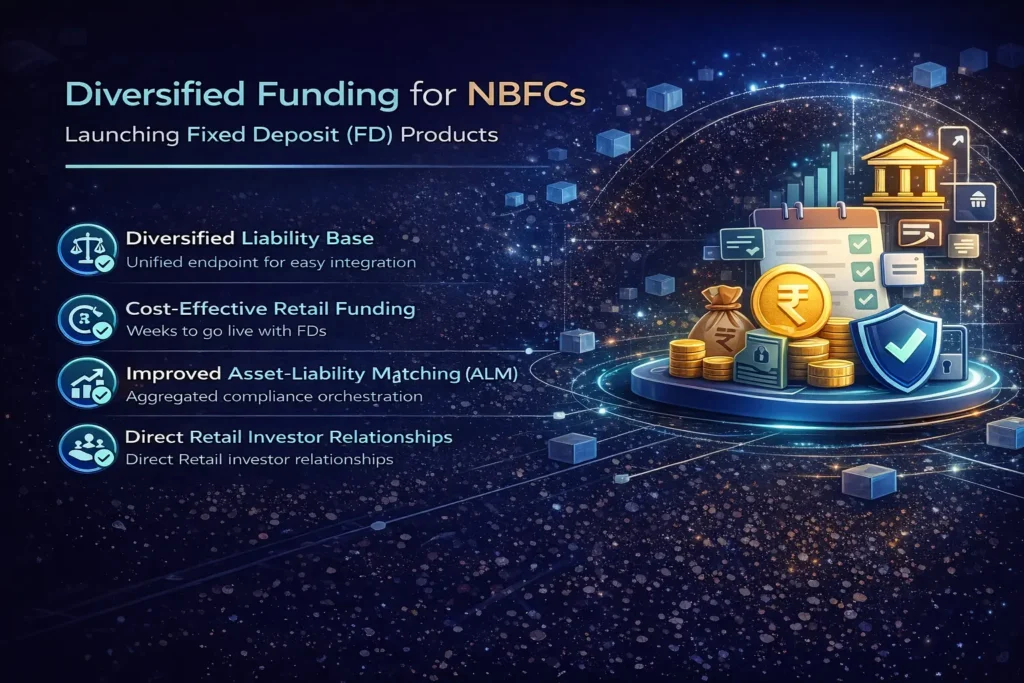
NBFC funding structure is not just a balance sheet component — it is the foundation of profitability, risk management, and long-term sustainability. Many NBFCs rely heavily on bank borrowings, market-linked instruments, securitization, or external commercial borrowings to fund their lending operations. While these channels provide scale, they also introduce concentration risk, refinancing pressure, and cost volatility. Launching Fixed Deposit (FD) products offers NBFCs a powerful opportunity to diversify funding sources, improve cost predictability, and build direct retail investor relationships. When executed strategically, deposit mobilization strengthens liability stability and enhances long-term resilience. Let’s explore how. Understanding the Funding Challenge for NBFCs NBFCs traditionally depend on wholesale borrowing. This includes term loans from banks, issuance of Non-Convertible Debentures (NCDs), and structured finance instruments. While effective in growth phases, wholesale funding can become expensive or constrained during liquidity tightening cycles. In periods of market stress, refinancing risk increases and cost of funds can spike. Overdependence on a limited set of funding channels exposes NBFCs to systemic shocks and rating pressure. Diversification is therefore not optional — it is essential. Retail fixed deposits introduce a more granular, diversified liability base that reduces reliance on concentrated institutional lenders. Why Fixed Deposits Are Strategic for NBFCs Retail FDs provide NBFCs with access to a broad base of individual investors seeking stable returns. Unlike wholesale funding, which may involve large-ticket lenders, retail deposits distribute liability across thousands of small investors. This distribution reduces concentration risk and strengthens liquidity buffers. Retail deposits also tend to be relatively stable compared to market-linked instruments. Investors holding FDs typically commit funds for defined tenures, offering predictable maturity schedules and better asset-liability matching. Moreover, FDs can improve cost optimization if structured correctly. NBFCs with strong credit ratings can often raise deposits at competitive rates while maintaining healthy spreads between borrowing cost and lending yield. Regulatory Framework and Eligibility NBFCs cannot accept public deposits unless specifically authorized. Only deposit-taking NBFCs that meet Reserve Bank of India (RBI) criteria can launch fixed deposit schemes. These NBFCs must adhere to strict prudential norms, including capital adequacy requirements, credit rating thresholds, and deposit caps linked to net owned funds. Compliance includes maintaining liquidity buffers, transparent disclosure norms, and adherence to deposit acceptance guidelines. While the regulatory bar is high, meeting it enhances credibility in the eyes of retail investors. Deposit-taking NBFCs that satisfy these standards gain the strategic advantage of diversified liability access. Building a Retail Deposit Franchise Launching an FD product is not merely about publishing interest rates. It requires building trust and distribution channels. Digital infrastructure now enables NBFCs to offer fully online FD booking journeys with integrated KYC, CKYC, and AML compliance. Instead of relying solely on branch-based models, NBFCs can distribute deposits through: Their own digital platforms Wealth management apps Investment marketplaces FD aggregators Strategic fintech partnerships By leveraging technology, NBFCs can scale retail deposit acquisition without proportional physical infrastructure expansion. Digital distribution reduces acquisition cost while expanding geographic reach. Improving Asset-Liability Matching (ALM) One of the core benefits of launching FDs is improved asset-liability management. NBFCs lend across various tenures — from short-term consumer loans to longer-term housing or SME financing. Without stable liabilities, mismatch risk increases. Fixed deposits provide defined tenure structures, allowing NBFCs to align borrowing duration with lending maturity profiles. For example, if an NBFC specializes in 24-month loans, it can structure FD products with similar tenure brackets to reduce mismatch. A well-balanced ALM structure improves credit ratings, lowers refinancing pressure, and enhances regulatory comfort. Enhancing Cost Stability Wholesale borrowing costs fluctuate based on liquidity conditions, policy rates, and credit market sentiment. Retail FDs, however, can provide more stable funding costs over fixed tenures. Even if deposit rates are slightly higher than short-term wholesale rates during favorable cycles, they offer insulation during tightening phases. This stability enables better interest margin planning and predictable earnings. Over time, a strong deposit franchise can reduce overall weighted average cost of funds. Strengthening Brand and Investor Trust Launching fixed deposits creates direct relationships with retail investors. Unlike institutional lenders, retail depositors engage with the brand personally. Transparent communication, timely interest payouts, and smooth maturity handling build credibility. This trust can translate into cross-selling opportunities, including recurring deposits, NCDs, or other investment products. A successful deposit program elevates the NBFC from a wholesale borrower to a recognized retail financial brand. Risk Considerations Diversification does not eliminate risk; it redistributes it. Deposit-taking NBFCs must manage: Liquidity buffers Regulatory reporting obligations Interest rate sensitivity Reputation risk Failure to honor maturity payments or delays in renewal handling can damage public trust rapidly. Therefore, lifecycle management systems for renewals, premature withdrawals, and closures must be robust and automated. Additionally, interest rate competition in the deposit market requires strategic pricing discipline. Offering unsustainably high rates to attract deposits may distort cost structures and compress margins. Strategic balance is essential. Technology as a Diversification Enabler Modern API-driven infrastructure enables NBFCs to launch digital FDs faster than ever. Instead of building complex systems from scratch, they can integrate deposit booking, compliance checks, payment systems, and reconciliation modules through standardized platforms. Digital onboarding reduces friction and expands reach beyond traditional geographic limits. Automated lifecycle management improves operational efficiency while maintaining compliance integrity. Technology lowers the barrier to entry while supporting scalable deposit mobilization. Strategic Impact on Long-Term Sustainability Diversifying funding sources through fixed deposits reduces reliance on cyclical wholesale markets. It improves resilience during liquidity crunches and strengthens creditworthiness. A diversified funding mix enhances negotiating power with banks and institutional lenders. When an NBFC is not solely dependent on wholesale funding, it gains strategic flexibility. Over time, a balanced mix of retail deposits and institutional borrowings creates a more stable liability structure that supports sustainable growth. Final Answer NBFCs can diversify funding sources by launching fixed deposit products that build a stable, retail-driven liability base. By mobilizing deposits from individual investors, NBFCs reduce concentration risk, improve asset-liability matching, stabilize funding costs, and enhance long-term financial resilience. Successful implementation requires regulatory compliance, digital infrastructure, disciplined pricing strategy, and strong lifecycle management

FD aggregator
Fixed Deposit

What Role Does an FD Aggregator Play Versus Building Direct Bank Integrations?

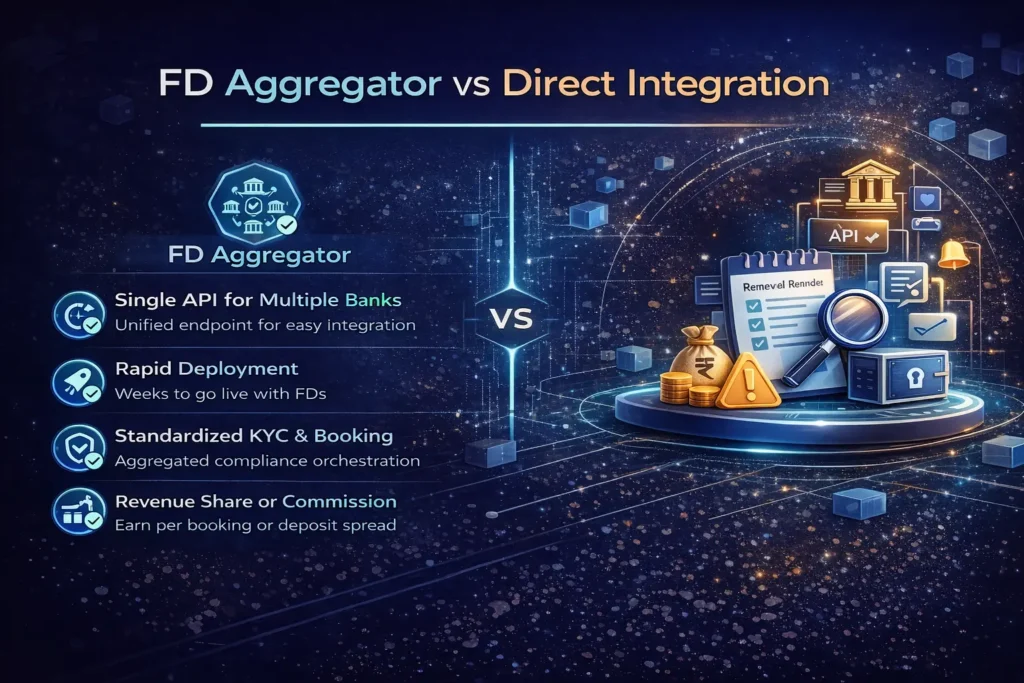
When launching a digital Fixed Deposit (FD) offering, institutions face a fundamental infrastructure decision: Do we integrate directly with banks? Or do we use an FD aggregator? This is not just a technical choice. It is a strategic decision that affects speed to market, operational complexity, scalability, compliance ownership, revenue structure, and long-term control. Let’s break this down clearly and structurally. What Is an FD Aggregator? An FD aggregator is a platform that connects multiple banks and NBFCs into a single unified API layer. Instead of integrating separately with each issuing institution, you integrate once with the aggregator, and they handle the orchestration behind the scenes. From your perspective, you get: A single API endpoint Access to multiple FD issuers Standardized KYC and AML workflows Unified booking, renewal, and closure flows Centralized reconciliation The aggregator acts as an infrastructure intermediary between distribution platforms and regulated deposit-taking institutions. What Is Direct Bank Integration? Direct integration means building individual technical connections with each bank or NBFC offering FDs. You connect your systems directly to their core banking system or deposit management APIs. Banks typically operate on core systems such as: Finacle TCS BaNCS Flexcube Each bank may have its own: API standards Compliance documentation Settlement processes Reporting formats SLA expectations Direct integration gives deeper control but significantly increases complexity. Core Differences: Aggregator vs Direct Integration Let’s examine this across key dimensions. 1. Speed to Market An FD aggregator dramatically reduces deployment time. Instead of negotiating and integrating with each bank separately, you plug into one infrastructure provider that already maintains these relationships. Direct integration, on the other hand, requires individual legal agreements, compliance reviews, API documentation alignment, and testing cycles for every bank. This can extend deployment timelines from weeks to several months. If speed is your priority, the aggregator model wins decisively. 2. Operational Complexity Aggregators standardize deposit workflows. They normalize rate structures, booking flows, renewal logic, and reporting formats across multiple issuers. Direct integration requires you to handle: Different interest calculation methods Separate reconciliation formats Individual KYC validation rules Bank-specific exception handling Over time, maintaining multiple integrations becomes operationally heavy unless you have a dedicated infrastructure team. 3. Control and Customization Direct bank integration offers deeper customization. You can negotiate specific rate structures, create custom tenure products, or integrate treasury-level configurations directly with the issuer. Aggregators typically offer standardized product configurations. While flexible to an extent, you may not get full control over rate experimentation or product structuring. If FD strategy is central to your long-term financial architecture, direct integration may offer strategic leverage. 4. Revenue Structure Aggregators often operate on revenue-sharing or commission models. You earn a portion of the deposit spread or a per-booking fee. With direct integration, you may negotiate better margins directly with banks, especially if you bring significant deposit volumes. However, you must also invest more in infrastructure and relationship management. Higher potential margin usually comes with higher operational burden. 5. Risk and Dependency Using an aggregator introduces vendor dependency. If the aggregator experiences downtime, compliance issues, or operational bottlenecks, your FD offering is impacted. With direct integrations, risk is distributed across individual bank relationships. However, system reliability depends entirely on how robust your internal infrastructure is. Aggregator dependency risk must be weighed against the complexity risk of managing multiple integrations internally. 6. Regulatory and Compliance Layer Aggregators often provide built-in orchestration for KYC, CKYC, AML screening, and reporting. They standardize compliance processes across issuers, reducing duplication. With direct integration, you must ensure compliance alignment separately with each bank’s internal policies and audit frameworks. This increases documentation and audit coordination effort. However, direct integration may give you more visibility into compliance data and risk assessment processes. When Does an FD Aggregator Make Strategic Sense? An FD aggregator model works best when: You want rapid deployment FD is an add-on product, not your core balance sheet focus You operate as a distribution-first fintech You lack deep internal banking infrastructure You prefer standardized product structures For wealth apps, super apps, and digital investment platforms, aggregators provide scalability with minimal engineering overhead. When Does Direct Bank Integration Make More Sense? Direct integration is better suited when: FD products are central to your financial strategy You want to build proprietary deposit infrastructure You need high customization flexibility You expect large deposit volumes and margin negotiation leverage You have strong technical and compliance teams Institutions building long-term deposit platforms with treasury alignment often prefer direct relationships. Hybrid Approach: The Emerging Model Some institutions begin with an aggregator to enter the market quickly. Once deposit volumes grow and operational maturity improves, they gradually build selective direct integrations with key banks. This hybrid approach balances speed and long-term control. You get: Fast initial deployment Early revenue generation Gradual transition toward deeper issuer relationships This staged strategy reduces early capital expenditure while preserving future flexibility. Strategic Perspective: Infrastructure vs Distribution The real decision comes down to identity. Are you an infrastructure-led financial institution?Or a distribution-led digital platform? If you are focused on customer acquisition, user experience, and cross-selling, an FD aggregator allows you to focus on growth rather than plumbing. If you see deposits as a strategic balance sheet driver, direct integration offers greater architectural control. Final Answer An FD aggregator acts as a centralized infrastructure layer that connects you to multiple banks through a single standardized API, reducing deployment time and operational complexity. Direct bank integration involves building individual technical and legal relationships with each issuer, offering deeper customization and potential margin advantages but requiring significantly higher operational effort. Choosing between them depends on your strategic priorities: speed versus control, standardization versus customization, scalability versus ownership. The most successful institutions evaluate not just the technical integration path — but the long-term role FD plays in their business architecture.

FD lifecycle management
Fixed Deposit

How Do We Manage FD Lifecycle Events Like Renewals, Premature Withdrawals, and Closures?

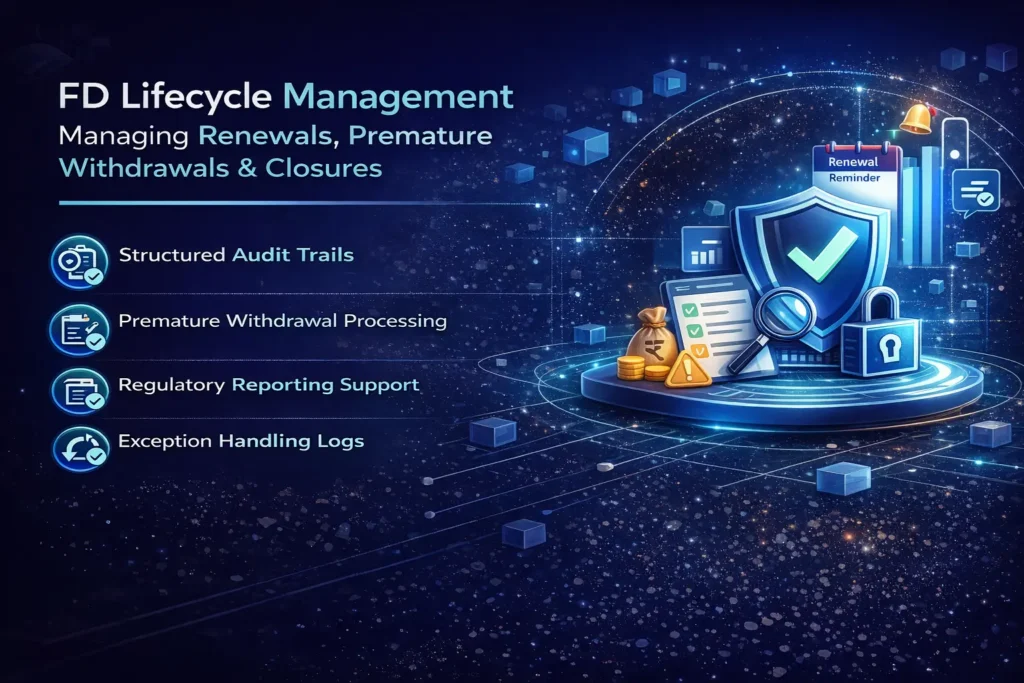
FD Lifecycle Management events is where operational maturity truly shows. Booking an FD is relatively straightforward. However, handling renewals, premature withdrawals, and closures requires precise orchestration across compliance systems, core banking infrastructure, accounting ledgers, and customer communication layers. If these processes are not structured correctly, institutions risk reconciliation errors, regulatory exposure, and customer dissatisfaction. A well-designed FD system treats lifecycle events as automated, event-driven workflows rather than manual interventions. Each event must trigger predefined system logic, accounting updates, compliance checks, and customer notifications in real time. Understanding the FD Lifecycle Management Framework An FD typically moves through five structured stages: booking, accrual period, pre-maturity notification, maturity action (renewal or payout), and closure. Every stage requires synchronization between customer-facing systems and backend core infrastructure. Most institutions rely on core banking systems such as Finacle, TCS BaNCS, or Flexcube, where deposit ledgers and interest engines operate. Lifecycle management systems must remain perfectly aligned with these cores to avoid ledger mismatches or reporting discrepancies. Lifecycle management is not just about changing status labels; it involves interest recalculation, regulatory compliance, tax adjustments, payout execution, and audit logging. Managing FD Renewals Renewals are strategically important because they determine deposit retention. A mature FD presents either a churn risk or a reinvestment opportunity. The renewal process should begin before maturity through automated reminders. Institutions typically trigger notifications 7 to 30 days prior to maturity. These alerts inform customers of the upcoming maturity date and provide renewal options such as renewing principal and interest, renewing only principal, modifying tenure, or closing the FD. From a system design perspective, renewal management must include dynamic interest rate logic. The system should determine whether renewal occurs at the prevailing rate on maturity day or under a promotional rate policy. This decision must align with treasury guidelines and regulatory norms. If customers do not provide explicit instructions, default rules apply. These rules might include automatic renewal for the same tenure at the prevailing rate or crediting funds to a linked savings account. These default policies must be clearly disclosed at booking to prevent future disputes. Technically, renewal triggers the creation of a new FD instance or updates the existing one depending on policy. The system recalculates interest schedules, generates updated certificates, and updates ledger entries. All actions must be timestamped and logged for compliance. Well-managed renewals increase retention rates and reduce cost of acquisition by converting maturing deposits into fresh investments seamlessly. Managing Premature Withdrawals Premature withdrawals introduce financial recalculations and compliance sensitivity. Customers may request early closure due to liquidity needs, and the system must respond instantly while applying correct penalty logic. Premature withdrawal handling begins with a customer request initiated digitally. The system calculates revised interest based on the actual duration completed rather than the original tenure. Additionally, a penalty rate reduction is applied as per institutional policy. This could involve reducing the applicable interest rate by a fixed percentage. The system must automatically recompute interest accrual, adjust any tax deductions such as TDS if applicable, and display the final payout amount transparently before customer confirmation. Transparency here reduces customer disputes significantly. After confirmation, the backend must update the FD status to prematurely closed, trigger payout to the linked account, adjust accounting ledgers, and generate a closure confirmation document. Every action must be recorded in audit logs for regulatory review. Operationally, premature withdrawal systems must also handle edge cases such as partial withdrawals (if allowed), high-value deposits requiring approval workflows, or flagged accounts under AML monitoring. Automation with structured controls ensures speed without compromising regulatory compliance. Managing Maturity Payouts and Final Closures If an FD reaches maturity without renewal, closure becomes the next lifecycle event. Closure involves final interest computation up to the maturity timestamp, payout execution, ledger updates, and regulatory reporting adjustments. On the maturity date, the system should automatically calculate total accrued interest. If auto-credit to a savings account is pre-selected, the payout must trigger instantly. If manual action is required, reminders should continue until the customer selects an option. Once payout is processed, the FD status changes to closed. A final digital certificate or closure confirmation is generated. Reporting systems must reflect the removal of that deposit from active balances. Closure workflows must synchronize with accounting systems to ensure liquidity ratios, deposit reporting, and internal dashboards update correctly. Any mismatch between customer-facing records and backend ledgers can create audit concerns. Effective closure handling ensures operational cleanliness and preserves institutional credibility. Communication and Notification Layer Lifecycle management is incomplete without proactive communication. Customers should never feel uncertain about maturity dates, penalty deductions, or payout amounts. Each lifecycle event should trigger structured notifications including maturity reminders, renewal confirmations, premature withdrawal summaries, payout acknowledgments, and final closure statements. Communication systems must be integrated with lifecycle triggers rather than handled manually. Real-time notifications reduce confusion and minimize support requests. Reconciliation and Compliance Control Every lifecycle event affects financial reporting and regulatory compliance. Renewals generate new deposit entries. Premature withdrawals adjust interest revenue. Closures alter liquidity positions. Institutions must implement automated reconciliation mechanisms that match lifecycle actions with payment confirmations and ledger updates. Audit logs should capture user actions, timestamps, transaction IDs, and recalculation logic. Regulatory frameworks require deposit records to be stored for extended retention periods. Therefore, lifecycle events must be fully traceable and reproducible. Without automated reconciliation and audit controls, scaling FD operations becomes risky and inefficient. Automation vs Manual Oversight While automation drives efficiency, certain high-risk cases may require manual oversight. High-value premature withdrawals, AML-flagged accounts, or system discrepancies may trigger review workflows before final execution. The ideal system design enables automation by default while allowing structured manual intervention with complete logging. This balance ensures scalability without sacrificing compliance rigor. Strategic Perspective FD lifecycle management is not a secondary process. It directly impacts retention, customer satisfaction, regulatory standing, and operational scalability. Institutions that treat lifecycle management as a core infrastructure layer rather than an afterthought achieve smoother renewals, fewer disputes, and stronger deposit stickiness. The difference between a functional FD platform and a scalable one lies in how

FD SDK
Fixed Deposit

How Does an FD SDK Support Audit, Reconciliation, and Regulatory Reporting?

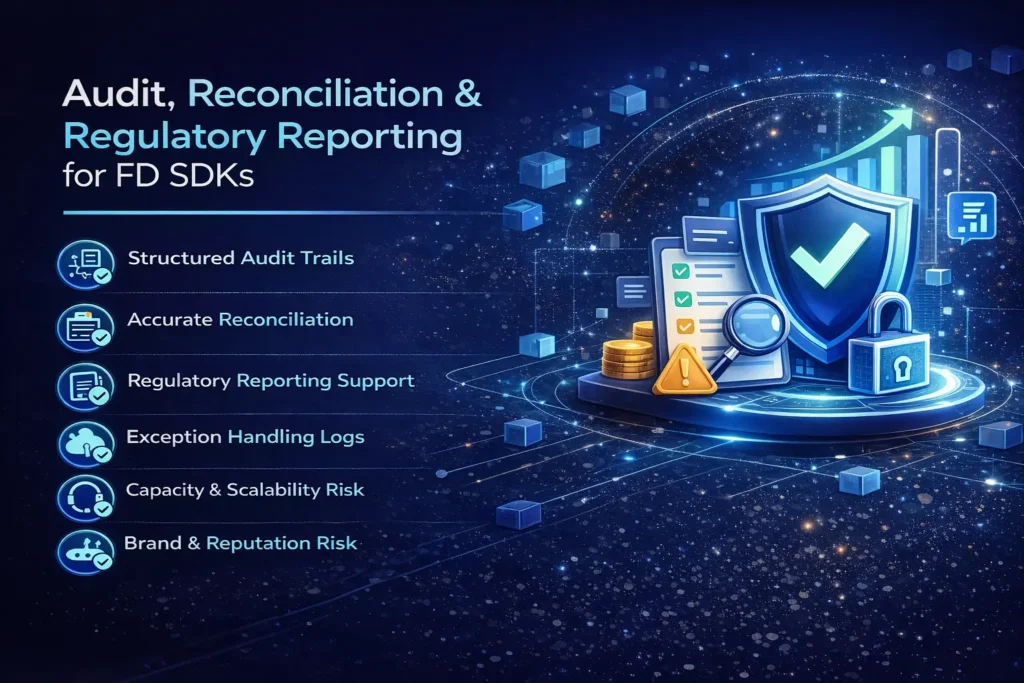
When financial institutions or fintech platforms launch Fixed Deposit (FD) products digitally through an SDK model, the focus is often on speed to market and customer experience. However, beyond onboarding journeys and booking flows lies a far more critical dimension: audit integrity, reconciliation accuracy, and regulatory reporting compliance. An FD SDK is not merely a technical integration layer. It becomes part of the financial control environment. Therefore, its ability to support audit trails, ensure transaction-level reconciliation, and align with regulatory reporting standards is central to long-term sustainability. Understanding how an FD SDK supports these functions helps institutions assess operational robustness before entering a distribution partnership. Structured Audit Trails Across the Entire FD Lifecycle Audit readiness begins with traceability. Every FD transaction — from rate display to final maturity payout — must be fully traceable through structured logs and system records. A well-designed FD SDK captures time-stamped records of: Customer consent and disclosures Rate selection and tenure confirmation KYC validation events Payment initiation and confirmation FD creation reference numbers Maturity instructions or renewal selections Premature withdrawal requests These logs must be immutable and securely stored. Financial audits often require transaction reconstruction, meaning institutions must be able to replay the sequence of events that led to an FD booking or closure. The SDK should maintain standardized logging formats with unique transaction IDs, allowing internal audit teams to map frontend user actions to backend ledger entries without ambiguity. Without structured logs, even minor discrepancies become difficult to investigate. Real-Time and Periodic Reconciliation Mechanisms Reconciliation ensures that what the customer sees, what the platform records, and what the partner bank or NBFC reflects are perfectly aligned. An FD SDK supports reconciliation by acting as an orchestration layer between: The distribution platform The payment gateway The partner institution’s core system The internal ledger or reporting system Reconciliation workflows typically operate on multiple layers. At the transaction level, the SDK verifies that payment confirmation matches FD booking confirmation. If a payment is successful but FD creation fails, the system should trigger automated reconciliation logic to retry booking or initiate refunds. At the end-of-day level, batch reconciliation compares all transactions processed during the day against partner institution confirmations. Any mismatches must be flagged immediately for review. A mature SDK should provide reconciliation dashboards showing: Successful bookings Failed transactions Pending confirmations Settlement status Exception logs Timely reconciliation reduces financial exposure and minimizes manual intervention. Alignment with Core Banking and Ledger Systems Since FDs ultimately reside on regulated institutions’ balance sheets, data synchronization between the SDK and the partner’s core system is critical. An FD SDK must ensure: Accurate interest rate mapping Tenure alignment Compounding logic consistency Ledger entry accuracy Settlement confirmation Even a minor discrepancy in rate calculation or maturity amount can create financial liability. The SDK should perform validation checks before final booking confirmation, ensuring that the frontend rate displayed matches the rate configured at the partner institution level. Ledger mapping is particularly important for audit purposes. Every booking must generate structured entries that align with the accounting system’s standards. Without this alignment, financial reporting becomes fragmented and audit complexity increases significantly. Regulatory Reporting Support Fixed Deposits are regulated financial instruments. In India, institutions distributing or originating FDs must comply with reporting standards governed by the Reserve Bank of India. Regulatory reporting may require structured data related to: Aggregate FD volumes Interest payout commitments Customer categorization (retail vs institutional) Maturity bucket distribution Premature withdrawal trends An FD SDK supports regulatory reporting by standardizing data capture at the transaction level. Each booking must store structured fields that can later be aggregated into compliance reports. This includes maintaining: Timestamped booking data Rate version history Tenure categorization Geographic distribution (if applicable) Tax deduction indicators The SDK should enable exportable reports in predefined formats, allowing compliance teams to generate regulatory submissions without manual data compilation. Automation reduces reporting errors and improves regulatory confidence. TDS and Tax Reporting Integration Interest income from FDs often attracts Tax Deducted at Source (TDS). Accurate calculation and reporting of TDS are operationally critical. An FD SDK must ensure: Correct TDS threshold checks PAN validation Senior citizen rate mapping TDS deduction logic based on tenure Annual interest certificate generation From an audit perspective, institutions must demonstrate how TDS was calculated and deducted. Therefore, the SDK should store tax computation logic transparently and maintain calculation records for review. Mismatch in TDS reporting can result in customer disputes and compliance exposure. Exception Handling and Escalation Logs No system operates without exceptions. What matters is how exceptions are tracked and resolved. An enterprise-grade FD SDK maintains detailed exception logs that capture: API failures Payment mismatches Booking confirmation delays Rate version conflicts Settlement discrepancies Each exception should have a defined resolution workflow and timestamped resolution status. Audit teams often examine not just successful transactions but how failures were handled. Therefore, exception transparency strengthens control confidence. Version Control and Change Documentation Interest rates change. Regulatory guidelines evolve. API versions are updated. An FD SDK must maintain version control documentation showing: When rate tables were updated When API endpoints were modified When new compliance disclosures were added This documentation becomes critical during audits. Institutions must demonstrate that customers received accurate rate information at the time of booking. Version logs allow reconstruction of historical conditions even years later. Without version traceability, historical disputes become difficult to resolve. Data Security and Access Audit Trails Audit integrity also extends to data access. The SDK should implement: Role-based access control Admin activity logging Data modification tracking Secure storage encryption Access logs must record who viewed, modified, or exported sensitive data. Financial institutions are expected to demonstrate that customer information is protected and that internal misuse risk is mitigated. Audit readiness is incomplete without access governance transparency. Independent Audit Support and Certification Some FD SDK providers undergo third-party security and compliance audits to demonstrate operational maturity. Certifications related to information security management and cloud security practices provide additional confidence. Although certification does not eliminate risk, it strengthens the control framework and simplifies due diligence. Institutions integrating with

Scroll to Top
Good move, automating your backend!