Finspring

Fixed Deposit

digital FD launch
Fixed Deposit

What Operational Risks Should Be Assessed Before Launching an FD Product Digitally?

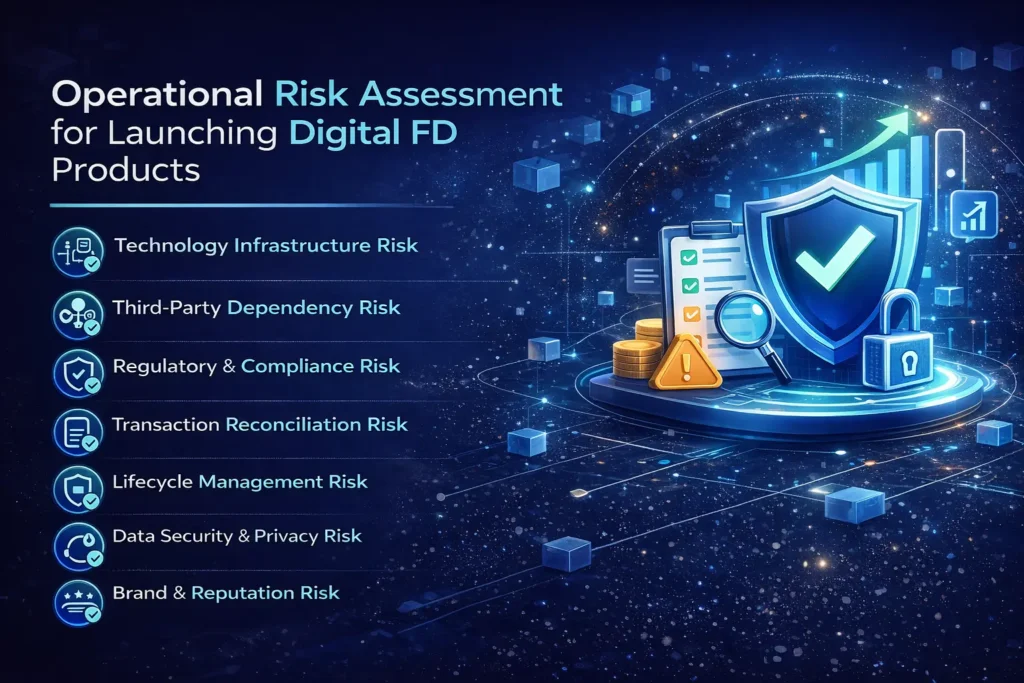
Digital FD launch product may appear straightforward on the surface. The product itself is simple, regulated, and widely understood. However, when distributed through digital channels — especially via SDKs, aggregators, APIs, or embedded finance models — the operational complexity increases significantly. Before going live, financial institutions, NBFCs, fintech platforms, and neobanks must conduct a structured operational risk assessment. Overlooking hidden dependencies can lead to transaction failures, reconciliation mismatches, compliance exposure, or reputational damage. Here are the key operational risks that must be evaluated before launching an FD product digitally. Technology Infrastructure Risk The first operational layer to assess is technology stability. Digital FD journeys involve multiple system interactions — frontend UI, API gateways, KYC services, payment processing, core banking systems, ledger entries, and notification engines. If any of these components are poorly integrated or lack redundancy, failure at one node can cascade across the entire journey. Key questions to evaluate include: Is infrastructure built for 99.9%+ uptime? Is there auto-scaling during high inflow periods? Are failover mechanisms tested? Is real-time monitoring in place? Cloud deployment environments such as Amazon Web Services or Microsoft Azure may provide scalability, but architecture design still determines resilience. A weak infrastructure foundation can turn a marketing success into an operational crisis. Third-Party Dependency Risk Most digital FD models rely on external partners: FD aggregators or SDK providers Payment gateways KYC vendors Core banking API providers Every external dependency introduces risk. If the aggregator’s API goes down, your booking flow fails. If the payment gateway faces downtime, funds may be debited without confirmation. If KYC validation services slow down, onboarding friction increases. Operational assessment must include: SLA review Escalation matrices Backup vendors where possible Defined reconciliation processes Dependency mapping should clearly identify single points of failure. Regulatory and Compliance Risk FDs are regulated financial products. Digital distribution must comply with guidelines set by the Reserve Bank of India and other applicable authorities. Operational risks arise when: Disclosure language is unclear Rate changes are not updated in real time TDS deductions are miscalculated KYC processes are improperly executed Customer consent logs are not stored Digital journeys must ensure proper documentation, transparent interest rate communication, and accurate reporting. Compliance lapses are not minor operational errors — they can result in regulatory scrutiny, penalties, or suspension of product distribution. Transaction Failure and Reconciliation Risk One of the most significant operational risks is transaction mismatch. Consider this scenario: a customer completes payment, but the FD booking confirmation fails due to API timeout. Funds are debited, but no FD reference number is generated. Without robust reconciliation systems, such cases create: Customer anxiety Support escalation Financial liability Manual intervention workload Before launch, organizations must assess: Automated reconciliation timelines Retry logic for failed API calls Clear transaction status tracking T+0 or T+1 settlement clarity Ambiguous transaction states are among the most damaging operational failures in financial services. Lifecycle Management Risk Many platforms focus heavily on onboarding but underestimate lifecycle management complexity. Digital FD launch products must handle: Maturity alerts Auto-renewal execution Premature withdrawals Interest payout schedules Nominee updates If lifecycle flows are not automated and tested thoroughly, operational load increases significantly after launch. For example, delayed maturity credits can generate high volumes of support tickets and erode trust instantly. Operational readiness must include end-to-end lifecycle simulation — not just booking validation. Data Security and Privacy Risk Digital FD launch products involve sensitive personal and financial information: PAN details Aadhaar-linked KYC Bank account information Transaction histories Data breaches expose institutions to legal, regulatory, and reputational consequences. Operational risk assessment should evaluate: Encryption standards Access control mechanisms Data storage locations Audit logging systems Incident response protocols Security frameworks must align with industry standards and internal governance policies. Data risk is often invisible — until it becomes catastrophic. Capacity and Scalability Risk High interest rate campaigns or market shifts can cause sudden FD inflows. If systems are not stress-tested before launch, traffic spikes may result in: Server crashes API throttling Booking failures Delayed confirmations Operational readiness requires: Load testing beyond expected peak volumes Auto-scaling configuration validation Performance benchmarking Monitoring dashboards Scalability risk is especially critical for fintech platforms embedding FD offerings into super apps or high-traffic ecosystems. Customer Support Readiness Risk Digital launch often triggers a surge in queries: “When will my FD confirmation arrive?” “How do I download my receipt?” “Why is my maturity amount different?” “How do I withdraw early?” If support teams are not trained and prepared, response delays increase. Operational assessment should cover: Support training documentation Escalation workflows Defined turnaround times Ticket tracking tools FAQs aligned with real scenarios Poor post-launch support can damage a brand more than technical glitches. Settlement and Treasury Risk digital FD launch distribution affects treasury management and settlement flows. Operational risks include: Delayed fund settlement with partner institutions Liquidity mismatches Incorrect interest accrual posting Manual ledger reconciliation Finance and operations teams must align on settlement cycles, reporting formats, and audit readiness. Treasury risk is often overlooked by product teams but has direct financial implications. Brand and Reputation Risk In financial services, trust is the ultimate currency. A single operational failure — such as delayed maturity credit or unclear transaction confirmation — can create viral backlash on social media. Reputation risk assessment must include: Communication strategy during downtime Incident transparency policies Customer notification templates Defined PR response protocol Operational resilience protects not just systems, but brand equity. Governance and Audit Risk digital FD launch operations must maintain: Detailed audit logs Version control documentation Approval workflows Periodic internal reviews Without governance frameworks, even minor operational inconsistencies can escalate during audits. Risk assessment must involve compliance, IT, operations, and finance stakeholders — not just product teams. Building a Structured Operational Risk Framework Before launching an FD product digitally, institutions should conduct a structured risk assessment covering: Technology resilience Third-party dependencies Regulatory compliance Transaction reconciliation Lifecycle automation Data security Scalability readiness Support preparedness Treasury alignment Governance controls Digital distribution amplifies both opportunity and exposure. While the product itself may be stable and regulated, the operational ecosystem around it determines success.
FD SDK SLA
Fixed Deposit

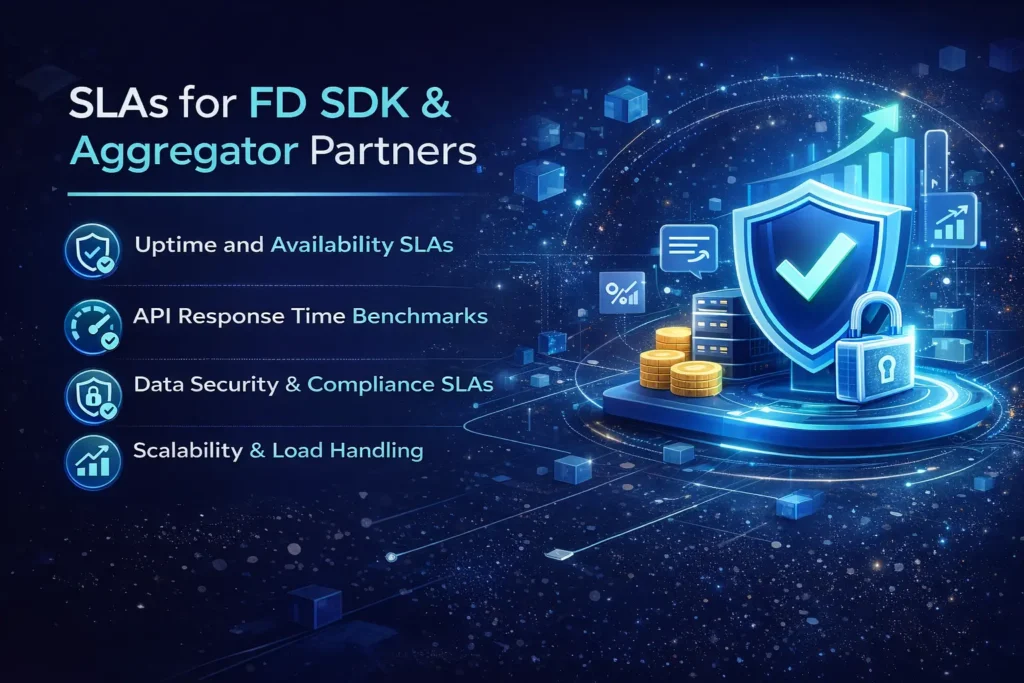
What SLAs Should We Expect from an FD SDK or Aggregator Partner?

As financial institutions, fintech platforms, NBFCs, and neobanks expand into digital Fixed Deposit (FD) distribution, many rely on SDK or aggregator partners to power the underlying infrastructure. While this approach accelerates go-to-market timelines, it also introduces dependency risk. That is why Service Level Agreements (SLAs) are not a formality — they are foundational to risk management, customer experience, and regulatory compliance. If you are evaluating or working with an FD SDK SLA or aggregator partner, here are the SLAs you should expect — and why each one matters. 1. Uptime and Availability SLAs The first and most critical SLA is uptime. Since FD booking is transactional and time-sensitive, your SDK partner must commit to at least 99.9% uptime, with clearly defined measurement windows (monthly or quarterly). For enterprise-grade deployments, 99.95% or higher should be the expectation. The SLA must specify: API availability percentage Scheduled maintenance windows Advance notice requirements Penalties for breaches Financial platforms cannot afford unexplained outages during rate campaigns or quarter-end inflow periods. If your aggregator’s API is down, your revenue pipeline is instantly affected. Additionally, uptime must apply to all critical endpoints, not just the booking API. This includes KYC validation, FD status checks, renewal flows, premature withdrawal endpoints, and reconciliation services. 2. API Response Time and Latency Benchmarks Availability alone is insufficient. Performance must be measurable. A reliable FD SDK should guarantee: Average API response time under 500 milliseconds Peak latency thresholds clearly defined Real-time monitoring transparency Slow APIs increase abandonment rates, especially during payment confirmation or maturity calculation stages. If your platform promises a seamless digital experience but the aggregator introduces latency, customer trust erodes quickly. Your SLA should include defined performance thresholds and escalation triggers if response times exceed agreed levels. 3. Transaction Success Rate Commitments FD booking flows involve multiple steps: KYC validation, rate confirmation, payment processing, ledger posting, and receipt generation. Your aggregator partner should provide a defined transaction success rate SLA, typically above 99%. This SLA must clarify: How failed transactions are categorized Retry logic responsibilities Time to reconcile ambiguous transactions Automatic refund timelines in case of booking failure No customer should experience a scenario where funds are debited but FD confirmation is unclear. The SLA must specify strict reconciliation timelines, ideally within T+0 or T+1 working day. 4. Data Security and Compliance SLAs Since FDs are regulated financial products, your aggregator must operate within the compliance framework defined by the Reserve Bank of India. Your SLA must confirm: Encryption standards (AES-256 or equivalent) Secure API communication (TLS 1.2 or higher) Data storage location compliance Access control and audit logging mechanisms Incident response timelines for data breaches Additionally, there must be clarity on data ownership. Your customer data should remain your asset, with explicit contractual protection against misuse. Compliance failure is not just technical risk — it is regulatory exposure. 5. Disaster Recovery and Business Continuity Guarantees A serious FD SDK partner should maintain a documented Disaster Recovery (DR) framework. The SLA must clearly state: Recovery Time Objective (RTO) Recovery Point Objective (RPO) Data replication strategy Secondary region failover For financial services infrastructure, RTO should ideally be under a few hours, with minimal data loss tolerance. You must also verify whether periodic DR drills are conducted and whether summary reports are shared with partners. Business continuity is not optional in regulated financial ecosystems. 6. Scalability and Peak Load Handling Commitments High FD inflow periods — especially during rate hikes or festive campaigns — can cause transaction volumes to surge dramatically. Your SLA should confirm: Maximum concurrent request capacity Auto-scaling capabilities Load testing benchmarks Historical peak performance data If the aggregator cannot handle volume spikes, your frontend platform suffers reputational damage. A credible partner should be able to demonstrate infrastructure scaling across platforms like Amazon Web Services or equivalent cloud environments. Scalability commitments must be documented — not assumed. 7. Lifecycle Event Processing SLAs Many platforms focus on booking SLAs but ignore lifecycle management. Your aggregator must define SLAs for: Maturity processing timelines Renewal execution Premature withdrawal settlement Interest payout credit timelines Nominee updates For example, if a customer requests premature withdrawal, the SLA should define whether funds are credited T+0, T+1, or later. Lifecycle inefficiencies generate the highest volume of support escalations. Therefore, SLAs must extend beyond onboarding. 8. Reconciliation and Settlement SLAs Financial accuracy is non-negotiable. The SLA must clarify: Daily reconciliation timelines Mismatch resolution process Settlement cycles with partner banks/NBFCs Audit report sharing frequency Reconciliation delays can create financial exposure and regulatory complications. A robust aggregator partner must provide transparent reporting dashboards for real-time tracking. Settlement clarity protects both your organization and end customers. 9. Support and Escalation SLAs Even the best systems encounter occasional issues. The difference lies in response quality. Your SLA should define: First response time (for critical issues) Escalation matrix 24/7 availability for high-severity incidents Dedicated relationship manager (for enterprise partners) For severity level 1 incidents — such as API downtime or transaction failures — response time should ideally be under 30 minutes. Support SLAs should include measurable turnaround times, not generic assurances. 10. Change Management and Update Notifications SDK-based integrations often evolve. API versions update, new features are introduced, and compliance changes occur. Your aggregator must commit to: Advance notice of API changes Backward compatibility support Sandbox testing environment Detailed integration documentation Unexpected changes can break production systems. Therefore, structured change management processes are essential. 11. Reporting and Analytics Transparency To optimize business performance, you need data visibility. Your FD SDK SLA should guarantee: Access to booking analytics Renewal conversion metrics Drop-off analysis Error logs Audit trails Without transparent reporting, it becomes difficult to optimize user journeys or identify operational bottlenecks. Data transparency strengthens the partnership. 12. Financial Penalty Clauses for FD SDK SLA Breaches An FD SDK SLA without consequences is merely a guideline. Contracts should include: Service credits for uptime breaches Financial penalties for repeated violations Termination rights for chronic underperformance This ensures alignment of incentives and accountability. Defining Enterprise-Grade Expectations Choosing an FD SDK or aggregator partner is not just

Digital FD
Fixed Deposit

How Do We Ensure Uptime, Scalability, and Performance During High FD Inflow Periods?

High Fixed Deposit (FD) inflow periods are both an opportunity and a stress test. Whether triggered by festive rate campaigns, quarter-end treasury allocations, regulatory changes, or sudden interest rate hikes, these spikes can multiply transaction volumes overnight. For digital FD platforms, the challenge is not attracting inflows — it is handling them without system slowdowns, booking failures, reconciliation mismatches, or customer frustration. Ensuring uptime, scalability, and performance during high FD inflow periods requires architectural discipline, operational foresight, and continuous monitoring. It is not a last-minute infrastructure upgrade; it is a deliberate engineering strategy built long before the traffic surge begins. Designing for High Availability from Day One High availability cannot be retrofitted into a platform that was designed for normal load conditions. Digital FD platforms must adopt a distributed architecture where services are decoupled and independently scalable. A monolithic system may function under steady traffic but often collapses under peak transactional bursts. Modern infrastructure strategies leverage cloud-native environments such as Amazon Web Services, Microsoft Azure, and Google Cloud Platform to create redundancy across multiple availability zones. This ensures that if one server cluster experiences failure, traffic automatically reroutes without disrupting customer journeys. The uptime benchmark for financial platforms today is 99.9% to 99.99%. During high FD inflow periods, anything less creates revenue leakage and reputational damage. True uptime resilience depends on load balancers, failover configurations, container orchestration, and infrastructure monitoring working in synchrony. Auto-Scaling to Handle Traffic Surges High FD inflow periods often follow predictable patterns — festive seasons, financial year-end, special rate campaigns, or regulatory announcements. However, the magnitude of traffic can still exceed projections. Auto-scaling mechanisms ensure that infrastructure expands dynamically when CPU usage, memory utilization, or API request rates exceed defined thresholds. Instead of provisioning static capacity (which is expensive and inefficient), auto-scaling allows the system to respond in real time. Container orchestration systems like Kubernetes are frequently used to spin up additional application pods during peak loads and scale them down once demand normalizes. This elasticity ensures that booking journeys remain smooth even when concurrent users spike dramatically. Without auto-scaling, digital FD platforms risk slow page loads, API timeouts, and incomplete transaction states — all of which directly impact conversion rates. Decoupling Critical Services to Prevent Bottlenecks One of the most common reasons platforms fail during high inflow periods is service interdependency. If FD booking, KYC validation, payment confirmation, ledger posting, and notification services operate within tightly coupled systems, a slowdown in one component cascades across the entire ecosystem. To prevent this, platforms should adopt microservices architecture where each function operates independently. For example, KYC verification should not block the booking confirmation API. Instead, event-driven architecture using asynchronous message queues allows booking confirmation to proceed while secondary validations occur in parallel. Message brokers like Apache Kafka or similar event streaming systems ensure that transactional data flows reliably between services even under heavy load. By decoupling services, platforms reduce the risk of systemic failure. Optimizing Database Performance Under Heavy Transactional Load During high FD inflow periods, database performance becomes a critical bottleneck. Every FD booking involves writing customer data, tenure details, rate information, payment confirmation status, and ledger entries into structured databases. If the database layer is not optimized, it becomes the single point of failure. Platforms must use read replicas to distribute query loads and implement indexing strategies for frequently accessed fields. Write-heavy systems benefit from database partitioning, ensuring that transactional entries are distributed across segments rather than centralized in a single table. Financial platforms often rely on managed database services offered by cloud providers to maintain high availability and automated backups. Database health monitoring must include metrics such as query latency, lock contention, and replication lag to prevent performance degradation. When inflow volumes surge, even a few milliseconds of delay per transaction can compound into major slowdowns. Payment Gateway Resilience and Redundancy FD booking is inseparable from payment processing. During peak inflow periods, payment gateway APIs experience high traffic volumes as customers complete transactions. Platforms must integrate with multiple payment gateways rather than relying on a single provider. If one gateway experiences downtime or latency issues, traffic should automatically route to an alternative provider. Payment confirmation mechanisms must include retry logic and reconciliation workflows to ensure that no transaction remains in an ambiguous state. A payment debited without FD confirmation creates customer anxiety and increases support tickets dramatically. Ensuring redundancy at the payment layer is as critical as server scalability. Real-Time Monitoring and Incident Response High inflow periods demand real-time visibility into system health. Monitoring tools should track: API latency Error rates Server CPU and memory usage Database performance Payment success ratios Queue backlogs If anomalies appear, automated alerts must notify engineering teams immediately. Proactive monitoring enables corrective action before customers notice disruption. A mature platform maintains a dedicated war-room strategy during known peak periods, where engineering, DevOps, and support teams monitor dashboards continuously. Quick response reduces downtime from minutes to seconds. Uptime during high FD inflow periods is not just technical; it is operational discipline. Stress Testing Before Peak Events Load testing and stress testing simulate high concurrency scenarios before actual inflow spikes occur. Platforms should simulate traffic 2x or even 5x higher than expected volumes to identify weak points. Tools that generate concurrent booking requests, payment flows, and dashboard queries help teams understand how the system behaves under pressure. Bottlenecks often appear in unexpected layers — caching systems, logging services, or third-party API integrations. Stress testing should not be a one-time event. It must occur before every major campaign or rate revision period. Caching and Performance Optimization To reduce backend load, platforms should cache static or semi-static data such as interest rate tables, tenure lists, FAQs, and eligibility criteria. This reduces database hits and speeds up page loads. Content delivery networks (CDNs) distribute static assets across geographies, improving load times for users accessing the platform from different regions. During high inflow periods, even minor performance improvements can significantly enhance booking completion rates. Ensuring Partner Bank and NBFC Coordination Digital FD platforms often

API infrastructure meaning
Fixed Deposit

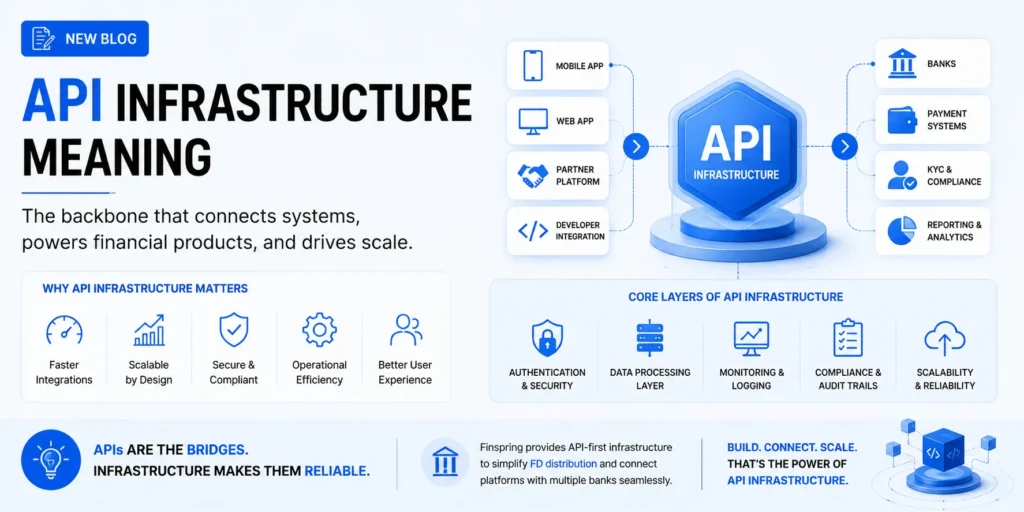
API Infrastructure Meaning: A Beginner’s Guide to the Backbone of Modern Fintech

If you’ve explored fintech, banking technology, or modern financial products, you’ve likely encountered terms like API infrastructure, API-first platforms, or financial infrastructure APIs. These terms often sound highly technical, making many founders, operators, and even banking teams assume API infrastructure is something only engineers need to understand. In reality, understanding API infrastructure meaning is increasingly important for anyone building or distributing financial products. Whether you’re launching payment systems, embedded finance experiences, or fixed deposits (FDs), API infrastructure is often the invisible layer powering everything. This guide explains API infrastructure in simple terms and explores why companies like Finspring rely on API-driven systems to make financial products scalable. What Does API Infrastructure Mean? API infrastructure refers to the systems, architecture, tools, and workflows that allow different software platforms to communicate and exchange information through APIs (Application Programming Interfaces). Think of APIs as bridges between systems. API infrastructure is everything required to ensure those bridges: Work reliably Remain secure Handle large volumes Scale over time Support real-time communication Without API infrastructure, digital financial ecosystems would become fragmented and difficult to operate. A Simple Analogy: API Infrastructure as Roads Imagine: Banks = Cities Apps = Buildings Financial products = Services APIs = Roads connecting everything API infrastructure is the entire transportation system: Highways Traffic controls Security checkpoints Maintenance systems Monitoring tools The roads alone are not enough. The supporting infrastructure matters. Why API Infrastructure Exists Traditional financial systems relied heavily on isolated software environments. If a new platform wanted to integrate: Payments Deposits KYC verification Banking products development was often slow and manual. API infrastructure changed this by enabling systems to connect instantly. Benefits include: ✓ Faster integration✓ Better scalability✓ Reduced development effort✓ Easier expansion into new products Core Components of API Infrastructure Understanding API infrastructure becomes easier when broken into layers. 1. APIs (The Communication Layer) APIs allow systems to request information or trigger actions. Examples: An app may request: Interest rates User verification FD availability The API returns the response. 2. Authentication Systems Infrastructure must determine: “Who is allowed access?” This includes: Tokens API keys Permissions Security protocols Authentication protects sensitive financial information. 3. Data Processing Layer Once requests arrive, backend systems: Validate information Process transactions Execute workflows This layer handles actual logic. 4. Monitoring & Logging Modern API infrastructure tracks: Response times Errors Usage volumes Failures This supports reliability. 5. Compliance Layer Financial products require: KYC Reporting Audit trails Monitoring Compliance increasingly lives inside infrastructure. How API Infrastructure Works (Simple Example) Imagine a user books an FD through a fintech app. The process may look like this: Step 1: User clicks: Book Fixed Deposit ↓ Step 2: App sends API request ↓ Step 3: Infrastructure validates identity ↓ Step 4: FD system checks rates and availability ↓ Step 5: Transaction processed ↓ Step 6: Confirmation returned instantly The user sees only one action. Behind the scenes, multiple infrastructure layers interact. Traditional Systems vs API Infrastructure Area Traditional Banking Systems API Infrastructure Integration Manual Automated Speed Slow Real-time Scalability Limited High Updates Complex Flexible User Experience Fragmented Seamless Why API Infrastructure Matters in Fintech Fintech growth depends heavily on infrastructure. Companies compete on: Speed Reliability Product expansion User experience Strong infrastructure enables all four. Without scalable APIs: Launching products becomes slower. Compliance becomes harder. Distribution becomes fragmented. Examples of API Infrastructure in Financial Products API infrastructure powers: Payments Processing transactions between users and institutions. Digital Onboarding Handling: KYC Verification Authentication Embedded Finance Allowing financial products inside non-financial apps. Deposit Products & FDs Connecting platforms with banks. Compliance Monitoring Automating: Reporting Audit trails Alerts Where Finspring Fits into API Infrastructure Finspring operates within a specialized infrastructure layer focused on FD distribution and deposit products. Instead of banks or fintechs building everything themselves, Finspring provides API-driven infrastructure enabling FD access through one integration. This allows platforms to: Access multiple banks Launch FD offerings faster Automate compliance workflows Monitor infrastructure reliability Scale distribution efficiently In simple terms: Finspring turns complex FD operations into infrastructure that can be integrated programmatically. Example: API Infrastructure for FD Distribution Without infrastructure: Platform → Individual bank integrations → Manual workflows → Higher complexity With API infrastructure: Platform → Finspring API → Multi-bank access → Automated workflows Complexity decreases dramatically. Benefits of API Infrastructure Faster Product Launches Teams build quickly using existing infrastructure. Better Scalability Systems handle increasing usage without major rebuilds. Reduced Operational Burden Automation minimizes repetitive manual work. Improved Reliability Monitoring ensures better uptime. Easier Compliance Compliance becomes embedded rather than separate. Common Misconceptions About API Infrastructure Myth 1: APIs are only for developers Reality: Founders and operators increasingly need infrastructure understanding. Myth 2: Infrastructure equals backend coding Reality: Infrastructure affects: Growth Compliance Scaling Monetization Myth 3: Infrastructure matters later Reality: Poor infrastructure decisions create long-term bottlenecks. The Future of API Infrastructure Financial infrastructure is evolving toward: AI-driven workflows Real-time compliance Modular banking systems Embedded finance ecosystems Composable infrastructure Infrastructure will become increasingly invisible to users but more important operationally. Conclusion Understanding API infrastructure meaning is becoming essential for anyone involved in financial products. At its simplest: API infrastructure enables systems to communicate efficiently. At scale: It determines how fast products launch, how reliably they operate, and how easily businesses grow. Platforms like Finspring demonstrate how specialized infrastructure layers can simplify complex products like fixed deposits and make them accessible through APIs. Because in modern finance, the companies that scale fastest often aren’t the ones with the most products. They’re the ones with the strongest infrastructure behind them.

Fixed Deposit

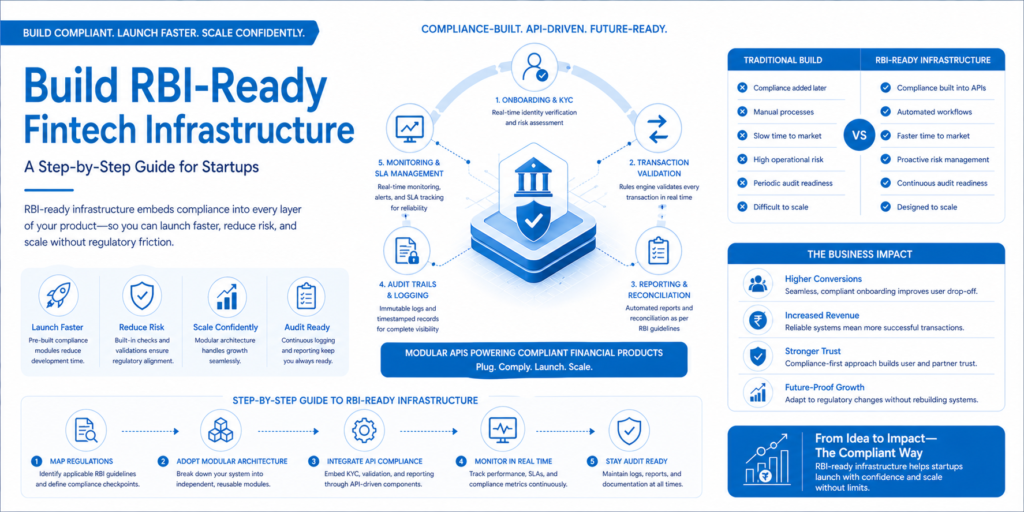
RBI-Ready Infrastructure Guide: Building Fintech Systems with Modular APIs

Launching a fintech product in India is no longer just a technology challenge—it is a regulatory engineering problem. Startups often focus on user experience, growth loops, and product-market fit, but overlook the structural reality that every financial product must operate within the frameworks defined by the Reserve Bank of India (RBI). Without the right infrastructure, even the strongest product ideas fail to go live or scale sustainably. This is where RBI-ready infrastructure becomes critical. It is not just about passing compliance checks; it is about building systems that are designed from the ground up to operate within regulatory boundaries, while still enabling speed, flexibility, and scalability. Modular API-based infrastructure is emerging as the most effective way to achieve this balance. What is RBI-Ready Infrastructure? RBI-ready infrastructure refers to a system architecture where compliance, reporting, transaction handling, and user flows are inherently aligned with RBI guidelines, ensuring that products can be launched, operated, and scaled without regulatory friction. Unlike traditional builds where compliance is layered on after development, RBI-ready systems: Embed regulatory logic into APIs Standardize workflows across products Automate reporting and audit readiness Ensure consistent adherence to guidelines This approach transforms compliance from a reactive requirement into a proactive capability. Why Startups Struggle with RBI Compliance For most startups, regulatory complexity becomes visible only after product development has already begun. This leads to delays, rework, and operational inefficiencies that slow down growth. Common challenges include: Unclear regulatory mapping, where teams are unsure how RBI guidelines translate into technical requirements Fragmented systems, with compliance handled separately from core product flows Manual processes, leading to delays in onboarding, verification, and reporting Dependency on multiple partners, each with different compliance standards These challenges create a situation where product readiness does not equal launch readiness, delaying time-to-market significantly. The Role of Modular APIs in RBI-Ready Infrastructure Modular APIs allow startups to build fintech systems in independent, reusable components, each responsible for a specific function such as onboarding, transaction processing, compliance validation, or reporting. This modular approach provides two key advantages: Flexibility: Teams can update or replace individual components without rebuilding the entire system Speed: Pre-built modules reduce development time and simplify integration When compliance is embedded within these modules, startups gain access to ready-to-use regulatory capabilities, eliminating the need to build them from scratch. Core Components of RBI-Ready Infrastructure 1. Compliance-Embedded Onboarding User onboarding must align with RBI requirements for KYC and identity verification. A robust system integrates: Real-time KYC APIs Document validation workflows Risk scoring mechanisms This ensures that onboarding is both fast and compliant, reducing drop-offs while maintaining regulatory integrity. 2. Transaction Validation Layer Every financial transaction must be validated against regulatory rules, including: Transaction limits Source and destination checks Fraud detection By embedding these checks into APIs, platforms can ensure that non-compliant transactions are blocked before execution, rather than flagged afterward. 3. Audit Trails and Logging RBI mandates detailed record-keeping for financial activities. Infrastructure must include: Immutable logs Timestamped event tracking User and system attribution This ensures that platforms remain audit-ready at all times, reducing the burden during regulatory reviews. 4. Reporting and Reconciliation Systems Accurate and timely reporting is a core requirement. RBI-ready systems automate: Transaction reporting Compliance documentation Reconciliation workflows Automation ensures that reporting is consistent, accurate, and scalable, even as transaction volumes increase. 5. Monitoring and SLA Management Real-time monitoring is essential to ensure system reliability and compliance. This includes: Performance tracking SLA adherence Alert systems for anomalies Monitoring ensures that issues are detected and resolved before they impact users or regulatory standing. Traditional vs RBI-Ready Infrastructure Aspect Traditional Fintech Build RBI-Ready Modular Infrastructure Compliance Integration Added later Built into APIs Time to Market Slow Fast Scalability Limited High Risk Management Reactive Proactive Audit Readiness Periodic Continuous Step-by-Step Guide to Building RBI-Ready Infrastructure Step 1: Map Regulatory Requirements Early Before building any product, startups must: Identify applicable RBI guidelines Translate them into technical requirements Define compliance checkpoints across the user journey This ensures that compliance is designed into the system, not added later. Step 2: Adopt Modular Architecture Break down the system into: Onboarding modules Transaction modules Compliance modules Reporting modules This modularity allows teams to build and scale efficiently, while maintaining flexibility. Step 3: Integrate API-Driven Compliance Use APIs to handle: KYC verification Transaction validation Reporting This reduces manual effort and ensures real-time compliance enforcement. Step 4: Implement Real-Time Monitoring Set up systems to track: Transactions Performance metrics Compliance deviations Real-time visibility ensures that issues are addressed proactively. Step 5: Ensure Audit Readiness Design systems that: Log every action Store data securely Generate reports instantly This ensures that audits can be handled without disruption. Key Benefits for Startups 1. Faster Launch Cycles With compliance built into infrastructure, startups can go live faster, capturing market opportunities without delays. 2. Reduced Operational Burden Automation eliminates the need for: Manual checks Repetitive workflows Cross-team coordination This allows teams to focus on growth. 3. Lower Risk Exposure Proactive compliance reduces the risk of: Regulatory penalties Operational failures Reputational damage 4. Scalable Growth Modular systems can handle increasing volumes without requiring major changes, enabling sustainable scaling. Example: FD Platform with RBI-Ready Infrastructure Stage Without RBI-Ready Infra With RBI-Ready Infra Onboarding Manual KYC delays Instant API-based verification Booking Multiple approvals Pre-compliant workflows Reporting Manual compilation Automated real-time reporting Audit Time-consuming Instant readiness The Role of Finspring Finspring enables startups to build RBI-ready FD infrastructure through: Modular APIs and SDKs Built-in compliance workflows Real-time monitoring and reporting Scalable architecture designed for growth This allows startups to move from: Idea → Integration → Launch → Scalewithout being slowed down by regulatory complexity. The Future of RBI-Ready Infrastructure As fintech continues to evolve, RBI-ready systems will become more advanced, incorporating: AI-driven compliance automation Predictive risk detection Real-time regulatory updates Deeper ecosystem integrations Startups that adopt this approach early will be better positioned to: Navigate regulatory changes Scale across markets Build long-term trust Conclusion Building fintech products in India requires more than innovation—it requires alignment with regulation at every level. RBI-ready infrastructure, powered by modular APIs,

Fixed Deposit

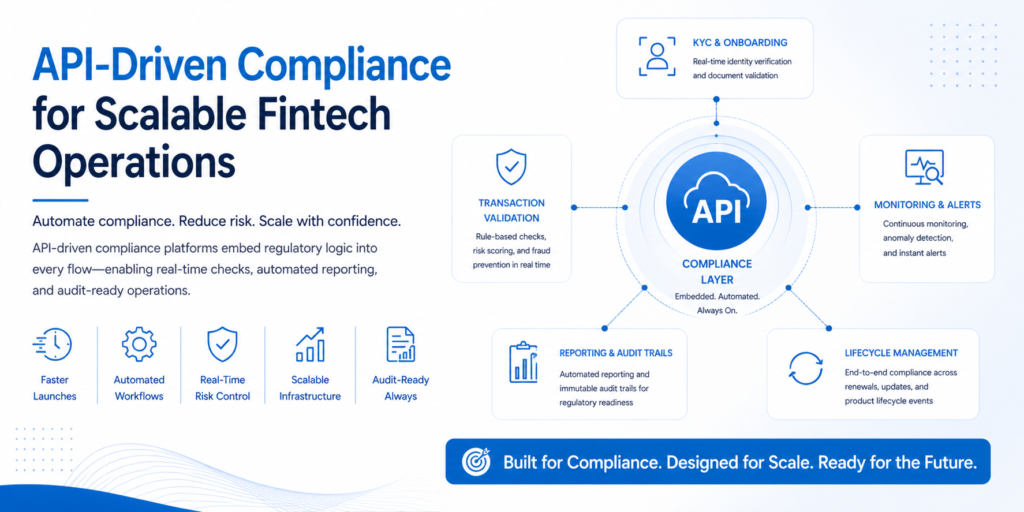
API-Driven Compliance Platforms: How Compliance is Automated in Fintech

As fintech platforms scale, compliance becomes one of the most complex and resource-intensive aspects of operations. Every user onboarding, transaction, and product lifecycle event must adhere to strict regulatory frameworks. Traditionally, this has meant manual checks, fragmented workflows, and delayed execution. However, the emergence of API-driven compliance platforms is transforming how compliance is handled—shifting it from a bottleneck to an automated, scalable system. API-driven compliance platforms embed regulatory logic directly into programmable interfaces, enabling fintechs to automate compliance processes in real time. This approach not only reduces operational overhead but also ensures that compliance scales seamlessly alongside product growth. What Are API-Driven Compliance Platforms? API-driven compliance platforms are infrastructure systems that expose compliance capabilities—such as KYC verification, transaction monitoring, audit logging, and reporting—through APIs. Instead of building compliance workflows manually, fintech platforms can integrate these APIs to automatically enforce regulatory requirements at every stage of the user and transaction lifecycle. This fundamentally changes how compliance is managed. Rather than being a separate function handled after product development, compliance becomes an integrated, real-time layer within the core system architecture, ensuring that every action taken on the platform is inherently compliant. Why Traditional Compliance Models Fail to Scale Traditional compliance systems were designed for slower, branch-based banking environments. As fintech shifts toward digital, real-time operations, these systems struggle to keep up. The reliance on manual processes, approval chains, and disconnected tools creates delays and inconsistencies that directly impact growth. Key limitations of traditional compliance models include: Manual dependency, which increases processing time and error rates Fragmented workflows, requiring coordination across multiple teams and systems Delayed validation, where compliance checks occur after transactions instead of during them Limited scalability, making it difficult to handle increasing transaction volumes These limitations make it clear that a new approach is required—one that aligns with the speed and scale of modern fintech systems. How API-Driven Compliance Automates the Process API-driven compliance platforms automate compliance by embedding checks and validations directly into the transaction flow. Instead of waiting for approvals or running separate verification processes, compliance is handled programmatically and instantly. Key Automation Layers: 1. Automated KYC & Onboarding APIs enable real-time identity verification by integrating with: Government databases Identity verification services Document validation systems This allows platforms to: Verify users instantly Reduce onboarding time Eliminate manual document checks 2. Real-Time Transaction Validation Every transaction can be validated against regulatory rules as it occurs. This includes: Transaction limits Risk scoring Fraud detection Instead of flagging issues after completion, API-driven systems prevent non-compliant transactions from being executed. 3. Continuous Monitoring & Alerts API-driven platforms provide real-time monitoring capabilities that: Track anomalies Detect unusual patterns Trigger alerts for potential violations This ensures that compliance is not a one-time check but a continuous process. 4. Automated Reporting & Audit Trails Compliance requires detailed reporting and record-keeping. APIs automate: Data collection Report generation Audit trail creation This ensures that platforms remain audit-ready at all times, without manual effort. 5. Lifecycle Compliance Management Beyond onboarding and transactions, compliance must be maintained throughout the product lifecycle. APIs handle: Renewals Status updates Event tracking This ensures that compliance is maintained consistently across all stages. Traditional vs API-Driven Compliance Aspect Traditional Compliance API-Driven Compliance Platforms Execution Manual and delayed Automated and real-time Integration Fragmented systems Unified API layer Scalability Limited High and system-driven Error Rate High Low due to automation Audit Readiness Reactive Continuous Key Benefits of API-Driven Compliance Platforms 1. Faster Product Launches By automating compliance workflows, platforms can reduce launch timelines significantly. There is no need to build or validate compliance systems from scratch, allowing teams to focus on product development and user experience. 2. Reduced Operational Overhead Automation eliminates the need for: Manual checks Repetitive workflows Cross-team coordination This leads to more efficient operations and lower costs. 3. Improved Accuracy and Consistency APIs enforce standardized rules across all transactions, reducing: Human errors Inconsistencies Compliance gaps This ensures that every action is handled uniformly. 4. Real-Time Risk Management With continuous monitoring and instant validation, platforms can: Detect issues early Prevent violations Respond proactively This significantly reduces risk exposure. 5. Scalability As transaction volumes grow, API-driven systems can scale without additional operational burden. This makes them ideal for platforms aiming for rapid expansion. Use Case: FD Infrastructure with API-Driven Compliance In FD distribution, compliance requirements include: KYC verification Documentation validation Transaction tracking Regulatory reporting Without API-Driven Compliance: Manual onboarding delays Multiple approval layers Slow reporting processes With API-Driven Compliance: Instant onboarding Automated transaction validation Real-time reporting Stage Without API Automation With API Automation Onboarding Manual KYC checks Instant verification via APIs Booking Approval delays Pre-validated workflows Reporting Manual compilation Automated real-time reports Audit Time-consuming Instant readiness Challenges in Implementing API-Driven Compliance While the benefits are clear, implementation requires careful planning. Key challenges include: Integration complexity, especially with legacy systems Regulatory alignment, ensuring APIs meet evolving standards Data security concerns, particularly when handling sensitive user information Dependency on external providers, which may impact reliability However, modern infrastructure platforms address these challenges by offering secure, standardized, and scalable solutions. The Role of Finspring Finspring enables API-driven compliance within FD infrastructure by embedding regulatory workflows directly into its system. This allows fintech platforms to: Launch FD products faster Ensure compliance at every stage Reduce operational complexity Maintain audit-ready systems By integrating once, platforms gain access to a fully compliant, scalable FD infrastructure, eliminating the need to build compliance systems independently. The Future of Compliance Automation The evolution of API-driven compliance is moving toward even greater intelligence and automation. Future developments will include: AI-driven compliance decision-making Predictive risk detection Real-time regulatory updates Deeper integration across financial ecosystems As these capabilities evolve, compliance will become increasingly invisible yet powerful, operating seamlessly in the background. Conclusion API-driven compliance platforms represent a fundamental shift in how fintech systems handle regulatory requirements. By automating compliance through APIs, platforms can eliminate bottlenecks, reduce risk, and scale efficiently. In modern financial infrastructure, compliance is no longer a separate function.It is an integrated, automated, and essential part of the system. Platforms that adopt API-driven compliance

Fixed Deposit

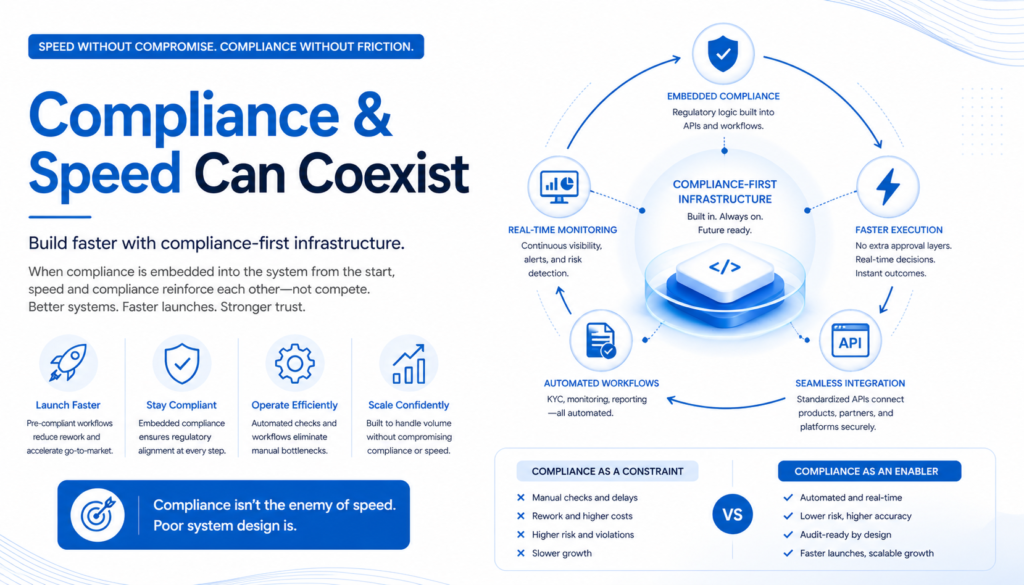
Compliance vs Speed in Embedded Finance: Breaking the False Tradeoff

In fintech, one of the most persistent assumptions is that compliance and speed are inherently in conflict. Founders believe that moving fast requires cutting through regulatory friction, while compliance teams are expected to slow things down to ensure safety and adherence. This perceived tradeoff has shaped how financial products are built, often forcing teams to choose between rapid execution and regulatory alignment. But this assumption is fundamentally flawed. The real issue is not that compliance slows down speed—it is that most systems are not designed to handle compliance efficiently. When infrastructure is fragmented or compliance is treated as an afterthought, delays become inevitable. However, with compliance-first embedded finance infrastructure, speed and compliance can reinforce each other rather than compete. Why the Compliance vs Speed Debate Exists The perception of a tradeoff comes from how traditional fintech systems have been built. Most platforms start with a product-first approach, focusing on user experience and core functionality. Compliance is then layered on top, often late in the development cycle. This creates friction because systems must be reworked to meet regulatory requirements, leading to delays and inefficiencies. In such setups, compliance introduces: Additional approval layers Manual verification processes Repeated checks across systems This makes compliance appear as a constraint on speed, when in reality it is a consequence of poor system design. The Reality: It’s a System Design Problem Speed and compliance are not opposing forces. They operate on different layers: Speed depends on how efficiently systems execute tasks Compliance depends on how accurately systems follow rules When systems are not designed to handle both simultaneously, friction emerges. The solution is not to compromise on either—but to build infrastructure that integrates both seamlessly. Traditional Thinking vs Modern Infrastructure Thinking Perspective Traditional Approach Compliance-First Approach View of Compliance Constraint Capability Speed Strategy Build fast, fix later Build right, launch fast System Design Fragmented Integrated Execution Reactive Proactive Outcome Delays and rework Faster, cleaner launches Where Speed Breaks Without Compliance Many fintech platforms attempt to prioritize speed by bypassing or minimizing compliance considerations early on. While this may accelerate initial development, it creates long-term challenges that ultimately slow down growth. Key failure points: 1. Rework After Development When compliance is not considered upfront, systems must be redesigned to meet regulatory standards. This leads to: Extended development cycles Increased costs Delayed launches 2. Operational Bottlenecks Manual compliance processes create dependencies across teams, slowing down: Onboarding Transactions Reporting As volume increases, these bottlenecks become more severe. 3. Regulatory Risk Skipping compliance or treating it as secondary increases the risk of: Violations Penalties Product shutdowns This risk forces platforms to slow down later, negating any early speed advantage. Where Compliance Breaks Without Speed On the other hand, over-engineered compliance systems can also create problems when they are not designed for speed. Common issues include: Overly complex workflows Excessive approval layers Lack of automation Slow response times This leads to: Missed market opportunities Poor user experience Reduced competitiveness The Shift: Compliance-First Embedded Finance The solution lies in compliance-first embedded finance infrastructure, where compliance is built into the system at a foundational level. Instead of adding compliance later, regulatory logic is integrated directly into APIs, workflows, and data structures. This approach ensures that: Every action is automatically compliant No additional approval layers are required Execution remains fast and consistent How Compliance Enables Speed When compliance is embedded into infrastructure, it removes the need for: Manual checks Repeated validations Cross-team coordination This allows systems to operate more efficiently, enabling faster execution across all stages. Key enablers: 1. Pre-Validated Workflows When workflows are designed to meet regulatory requirements from the start, there is no need for additional approvals. This reduces delays and accelerates product launches. 2. Automated Compliance Checks APIs can handle: KYC validation Transaction monitoring Reporting This eliminates manual intervention and ensures real-time compliance. 3. Standardization Across Systems A unified compliance layer ensures consistency across: Products Partners User journeys This reduces complexity and improves scalability. 4. Real-Time Monitoring Continuous monitoring ensures that: Issues are detected instantly Violations are prevented Systems remain aligned with regulations Compliance vs Speed: A Practical Comparison Factor Compliance as a Constraint Compliance as an Enabler Product Launch Delayed Accelerated Operations Manual and slow Automated and efficient Risk High Controlled Scalability Limited High User Experience Inconsistent Seamless Example: FD Infrastructure In FD distribution, the impact of compliance vs speed is clearly visible. Without Compliance-First Infrastructure: Manual KYC slows onboarding Multiple approvals delay booking Reporting requires manual effort With Compliance-First Infrastructure: Instant onboarding through APIs Pre-compliant booking flows Automated reporting and audit readiness Stage Without Integrated Compliance With Compliance-First Infra Onboarding Delayed Instant Booking Approval-heavy Seamless Reporting Manual Automated Audit Reactive Continuous The Strategic Advantage Platforms that resolve the compliance vs speed conflict gain a significant advantage. They can: Launch products faster than competitors Scale without operational friction Maintain regulatory alignment Deliver consistent user experiences This combination creates a compounding effect, where speed and compliance reinforce each other over time. The Role of Finspring Finspring is built on the principle that compliance and speed should not compete. By embedding compliance directly into its FD infrastructure, Finspring enables platforms to: Launch FD products quickly Maintain continuous regulatory alignment Scale without increasing complexity This allows fintech teams to focus on growth, while compliance operates seamlessly in the background. The Future: No Tradeoff As fintech infrastructure evolves, the idea of choosing between compliance and speed will become obsolete. Systems will be designed to handle both simultaneously, making compliance an invisible but powerful layer that supports rapid execution. The platforms that adopt this mindset early will define the next phase of embedded finance. Conclusion The debate between compliance and speed is not a real tradeoff—it is a reflection of outdated system design. With the right infrastructure, compliance can accelerate growth rather than hinder it. In modern fintech, success comes from building systems where: Compliance is automatic Speed is consistent Execution is frictionless Because the fastest platforms are not the ones that bypass compliance.They are the ones that build it into their foundation.

Fixed Deposit

SLA Tracking in Financial Infrastructure: Why Uptime and Reliability Define Success

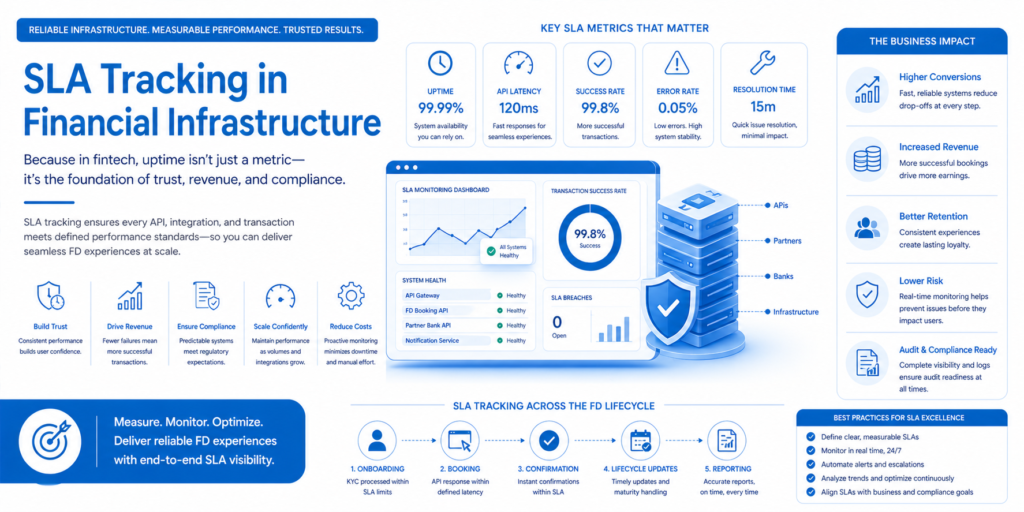
In financial infrastructure, performance is not just a technical metric—it is a direct driver of trust, revenue, and compliance. Unlike other industries where occasional downtime may be tolerated, even minor disruptions in financial systems can lead to failed transactions, user dissatisfaction, and regulatory risk. This is why SLA tracking (Service Level Agreement tracking) has become a foundational component of modern fintech infrastructure and it is important to resolve SLA tracking production issues. For products like Fixed Deposits (FDs), where users expect certainty and accuracy, infrastructure reliability must be measurable, enforceable, and continuously monitored. SLA tracking ensures that every system component—from APIs to partner integrations—operates within defined performance standards. What is SLA Tracking in Financial Infrastructure? SLA tracking refers to the process of defining, monitoring, and enforcing performance benchmarks for system components, services, and integrations. These benchmarks typically include: Uptime guarantees API response times Transaction processing speed Error rates Resolution times for issues In financial systems, SLA tracking ensures that these metrics are not just observed but actively managed in real time, allowing platforms to detect and resolve issues before they impact users or compliance obligations. Why SLA Tracking Matters in Fintech In fintech, infrastructure is the product. Users may interact with a simple interface, but their experience depends entirely on how reliably the backend performs. SLA tracking ensures that this reliability is consistent, measurable, and scalable. Key reasons SLA tracking is critical: Trust is time-sensitive: Delays in confirmations or updates reduce user confidence instantly Revenue depends on uptime: Failed transactions directly impact monetization Compliance requires consistency: Regulatory frameworks expect predictable system behavior Scale increases complexity: As volumes grow, so does the risk of performance degradation Without SLA tracking, platforms operate without visibility, making it difficult to maintain high performance standards. Core SLA Metrics in Financial Infrastructure Metric Description Why It Matters Uptime Percentage of system availability Ensures continuous access for users API Latency Time taken for API responses Impacts user experience and transaction speed Transaction Success Rate Percentage of successful transactions Directly affects revenue and trust Error Rate Frequency of system errors Indicates system stability Resolution Time Time taken to fix issues Determines recovery speed The Role of SLA Tracking in FD Systems Fixed Deposit systems require high reliability across multiple stages, including onboarding, booking, confirmation, and lifecycle management. Any delay or failure in these stages can disrupt user experience and create operational challenges. Example: FD Booking Flow with SLA Tracking Stage SLA Metric Impact of Failure Onboarding KYC processing time Delays reduce conversion rates Booking API response time Slow booking leads to drop-offs Confirmation Processing time Delayed confirmation reduces trust Lifecycle Updates Update frequency Inconsistent updates create confusion SLA tracking ensures that each stage operates within defined limits, maintaining consistency and reliability throughout the user journey. Common Causes of SLA Breaches Even well-designed systems can experience SLA breaches due to: 1. Partner Dependencies Financial platforms often rely on banks and third-party services. Delays or failures at the partner level can impact overall performance. 2. Infrastructure Bottlenecks High transaction volumes can strain systems that are not designed for scale, leading to latency and downtime. 3. Lack of Real-Time Monitoring Without continuous monitoring, issues go undetected until they impact users. 4. Manual Incident Management Slow response times increase the duration and impact of outages. How SLA Tracking Solves These Challenges 1. Real-Time Monitoring SLA tracking systems continuously monitor: API performance Transaction flows System health This ensures that issues are detected as they occur, not after they escalate. 2. Automated Alerts When performance deviates from defined SLAs, alerts are triggered instantly. This allows teams to: Identify root causes quickly Initiate corrective actions Minimize downtime 3. Performance Analytics SLA tracking provides insights into: System performance trends Bottlenecks Partner reliability This helps platforms optimize infrastructure proactively. 4. Accountability Across Systems By defining SLAs for each component, platforms can: Hold internal teams accountable Evaluate partner performance Ensure consistent service delivery Traditional Monitoring vs SLA-Driven Infrastructure Aspect Traditional Monitoring SLA-Driven Infrastructure Approach Reactive Proactive Visibility Limited Real-time Issue Detection Delayed Instant Scalability Limited High Reliability Inconsistent Predictable Best Practices for Implementing SLA Tracking 1. Define Clear SLAs Set measurable benchmarks for: Uptime Latency Transaction success Clarity ensures accountability. 2. Monitor Continuously Use real-time systems to track performance across: APIs Databases Integrations 3. Automate Alerts Ensure that any deviation from SLAs triggers: Immediate notifications Escalation workflows 4. Analyze and Optimize Regularly review performance data to: Identify patterns Improve systems Prevent future issues 5. Align SLAs with Business Goals SLA metrics should reflect: User expectations Revenue impact Compliance requirements The Business Impact of SLA Tracking SLA tracking is not just a technical requirement—it has direct business implications: 1. Higher Conversion Rates Reliable systems reduce drop-offs during onboarding and transactions. 2. Increased Revenue Fewer failed transactions mean more completed bookings and higher earnings. 3. Improved User Retention Consistent performance builds trust, leading to repeat usage. 4. Reduced Operational Costs Proactive issue resolution reduces the need for manual intervention. The Role of Finspring Finspring integrates SLA tracking into its FD infrastructure, enabling platforms to: Monitor performance in real time Track API and transaction-level SLAs Receive automated alerts for production issues Maintain high uptime and reliability This ensures that platforms can scale FD distribution without compromising performance or trust. The Future of SLA Tracking in Financial Infrastructure As fintech systems evolve, SLA tracking will become more advanced, incorporating: AI-driven performance prediction Automated incident resolution Cross-platform SLA orchestration Real-time optimization These advancements will make infrastructure more resilient, adaptive, and self-correcting. Conclusion In financial infrastructure, uptime is not just a technical metric—it is a core product feature. SLA tracking ensures that systems operate reliably, consistently, and at scale, enabling platforms to deliver seamless user experiences and maintain regulatory compliance. For FD systems and beyond, the ability to monitor and enforce performance standards is what separates fragile systems from scalable platforms. Because in fintech, reliability is not optional.It is the foundation of growth.

shared technology platform for cooperative banks
Fixed Deposit

Shared Tech Platforms for Banks: A Scalable Future for Cooperative Banking

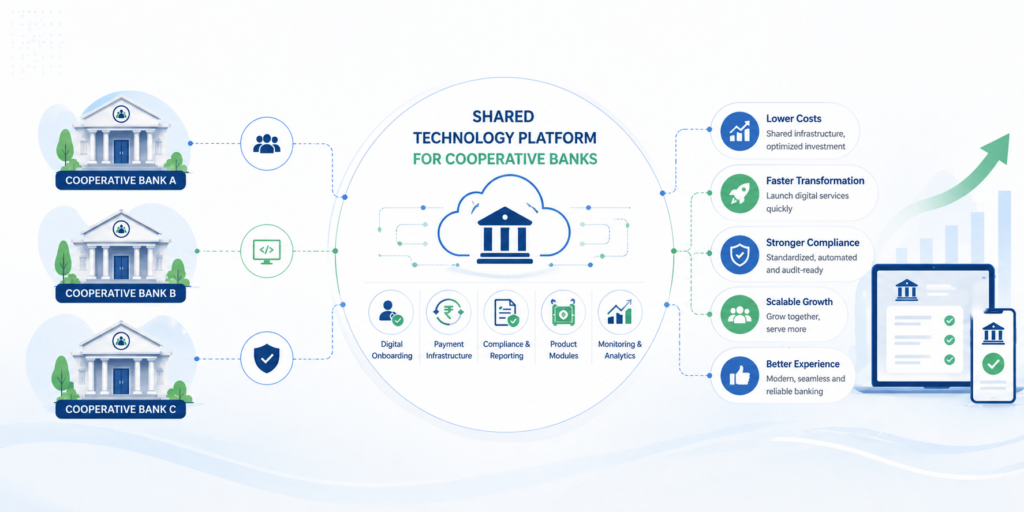
Cooperative banks have historically operated as independent entities, each managing its own systems, processes, and infrastructure. While this model supports autonomy, it also creates inefficiencies—especially in a digital-first world where speed, scalability, and integration define success. To bridge this gap, a new model is emerging: the shared technology platform for cooperative banks. Instead of each bank building and maintaining its own infrastructure, shared platforms enable multiple institutions to leverage a common, standardized technology layer. This approach reduces costs, accelerates digital transformation, and enables cooperative banks to compete effectively with fintech companies and larger financial institutions. In this article, we explore how shared technology platforms work, why they are critical for cooperative banks, and how infrastructure providers like Finspring enable this shift. What is a Shared Technology Platform for Cooperative Banks? A shared technology platform is a centralized infrastructure system used by multiple banks to deliver digital financial services. Instead of building separate systems for onboarding, payments, compliance, and product distribution, banks use a common platform that provides these capabilities through APIs and modular components. This platform typically includes: Digital onboarding systems Payment infrastructure Compliance and reporting tools Product modules (such as FDs) Monitoring and analytics By sharing this infrastructure, cooperative banks can operate on modern systems without individually investing in large-scale technology development. Why Cooperative Banks Need Shared Platforms 1. High Cost of Individual Infrastructure Building and maintaining modern banking systems requires: Significant investment Skilled technical teams Continuous upgrades For many cooperative banks, this is not feasible. 2. Fragmented Systems Independent systems often lead to: Inconsistent processes Integration challenges Operational inefficiencies 3. Increasing Digital Demand Customers expect: Instant services Mobile access Seamless experiences Meeting these expectations requires advanced infrastructure. 4. Regulatory Complexity Compliance requirements are becoming more complex, requiring: Real-time reporting Audit-ready systems Automated workflows Shared platforms simplify compliance by standardizing processes. How Shared Technology Platforms Work Shared platforms operate as centralized infrastructure layers that multiple banks can access and use. Each bank retains its identity and customer relationships while leveraging the platform for backend operations. Key characteristics: API-first architecture for easy integration Modular components that can be customized Multi-tenant systems supporting multiple banks Centralized updates ensuring consistency Traditional vs Shared Technology Models Aspect Independent Systems Shared Technology Platform Cost High Reduced Scalability Limited High Integration Complex Simplified Compliance Manual Automated Innovation Speed Slow Fast Core Components of a Shared Technology Platform 1. Digital Onboarding Module Provides: Online account creation KYC verification Automated workflows 2. Payment Infrastructure Enables: Real-time transactions Integrated payment channels Automated reconciliation 3. Compliance and Reporting Tools Includes: Audit trails Regulatory reporting Risk management systems 4. Product Modules Supports: Fixed deposits (FDs) Savings products Lending solutions 5. Monitoring and Analytics Tracks: System performance Transaction metrics User behavior Benefits of Shared Technology Platforms 1. Cost Efficiency By sharing infrastructure, banks can: Reduce development costs Lower maintenance expenses Optimize resource usage 2. Faster Digital Transformation Shared platforms provide ready-to-use capabilities, allowing banks to: Launch digital services quickly Avoid long development cycles 3. Standardization Uniform systems ensure: Consistent processes Easier integration Improved compliance 4. Scalability Platforms can handle: Increased transaction volumes Growing customer bases without requiring major changes. 5. Improved User Experience Modern infrastructure enables: Faster transactions Seamless onboarding Reliable services Challenges in Adopting Shared Platforms 1. Customization Concerns Banks may worry about: Losing control over processes Limited flexibility However, modern platforms offer modular customization. 2. Data Security Shared systems must ensure: Data isolation Secure access Regulatory compliance 3. Change Management Transitioning from legacy systems requires: Staff training Process adjustments Strategic planning The Role of API Infrastructure API infrastructure is the backbone of shared technology platforms. It enables: Seamless integration between modules Real-time data exchange Scalable system architecture Easy onboarding of new banks This ensures that shared platforms remain flexible and adaptable. How Finspring Enables Shared Technology Platforms Finspring plays a key role in enabling shared technology platforms for cooperative banks by providing API-first infrastructure for FD and deposit distribution. 1. Shared FD Infrastructure Finspring allows multiple banks to: Offer FDs digitally Access standardized workflows Scale distribution across platforms 2. Multi-Bank Integration Through a single API, banks can: Connect with multiple platforms Expand distribution channels Reach new users 3. Embedded Compliance Finspring integrates: KYC processes Reporting systems Audit trails ensuring compliance across all participating banks. 4. Real-Time Monitoring Banks can track: Transaction performance System health SLA metrics This ensures consistent service quality. Example: Shared Platform with Finspring Function Traditional Approach Shared Platform Approach FD Distribution Individual systems Shared API infrastructure Compliance Manual processes Automated workflows Integration Multiple setups Single integration Scaling Limited Seamless Strategic Impact for Cooperative Banks Shared technology platforms enable cooperative banks to: Compete with fintech companies Expand beyond local markets Improve operational efficiency Deliver modern user experiences This transforms them from: Isolated institutionsto Connected ecosystem players Best Practices for Implementation 1. Start with Core Services Focus on: Onboarding Payments Deposits (FDs) 2. Choose API-First Platforms Ensure that the platform: Supports modular integration Provides scalability Ensures compliance 3. Prioritize Security Implement: Data encryption Access controls Regular audits 4. Train Teams Ensure staff can: Use digital systems Manage workflows Support customers The Future of Shared Banking Infrastructure Shared technology platforms will continue to evolve with: AI-driven automation Real-time analytics Deeper ecosystem integrations Increased standardization These advancements will make banking: More efficient More scalable More accessible Conclusion The shared technology platform for cooperative banks represents a fundamental shift in how banking infrastructure is built and operated. By moving from isolated systems to shared, API-driven platforms, cooperative banks can overcome resource limitations and accelerate digital transformation. Finspring plays a critical role in this ecosystem by providing shared FD infrastructure, enabling banks to scale distribution, automate compliance, and deliver seamless financial experiences. Because the future of cooperative banking is not about building everything independently.It is about building together on systems that enable growth, efficiency, and innovation.

integrated payment systems for cooperative banks
Fixed Deposit

Payment Systems for Co-op Banks: Building Integrated, Scalable Infrastructure

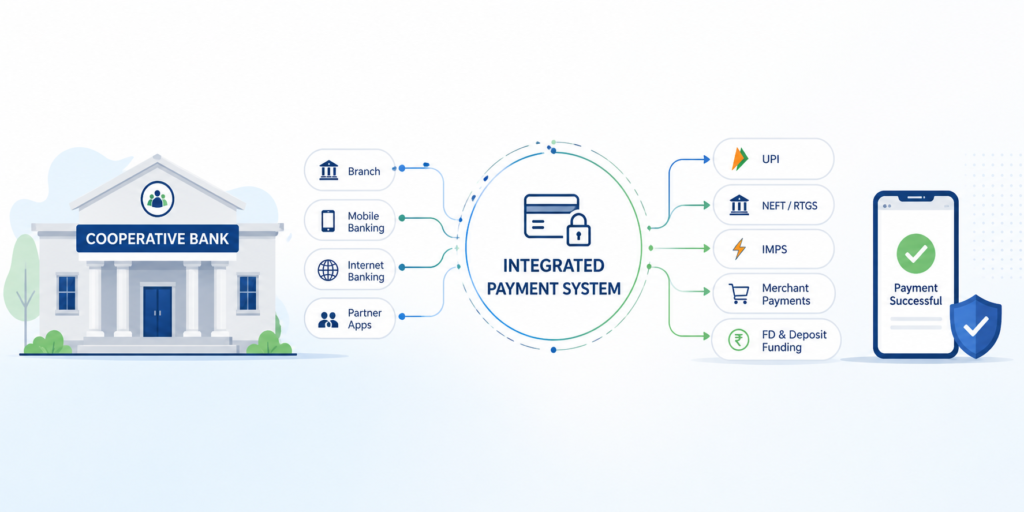
Cooperative banks have traditionally relied on localized operations, branch-led interactions, and manual processes to serve their communities. While this model built strong relationships, it is increasingly misaligned with today’s expectations of instant, digital, and seamless financial services. Payments sit at the center of this shift. To stay relevant and competitive, cooperative banks must adopt integrated payment systems for cooperative banks—systems that unify multiple payment channels, automate processes, and connect seamlessly with modern financial ecosystems. In this article, we explore what integrated payment systems are, why they matter, and how infrastructure platforms like Finspring enable cooperative banks to modernize their payment capabilities. What Are Integrated Payment Systems for Cooperative Banks? Integrated payment systems refer to unified platforms that connect multiple payment methods, channels, and backend processes into a single, cohesive infrastructure. Instead of operating separate systems for different payment types, banks can manage everything through one integrated layer. These systems typically include: Digital payments (UPI, NEFT, RTGS, IMPS) Internal fund transfers Merchant payments Deposit-related transactions (such as FD funding) Reconciliation and reporting systems The goal is to create a centralized yet flexible system that enables seamless transaction processing across all channels. Why Cooperative Banks Need Integrated Payment Systems The need for integrated payment systems is driven by several structural changes in the financial ecosystem. 1. Rising Digital Payment Adoption Customers increasingly prefer: Mobile payments Instant transfers Cashless transactions Without integrated systems, cooperative banks struggle to meet these expectations. 2. Fragmented Legacy Systems Many cooperative banks operate with: Separate systems for each payment type Limited integration capabilities Manual reconciliation processes This fragmentation leads to inefficiencies and errors. 3. Regulatory Requirements Payment systems must comply with: Reporting standards Transaction monitoring Audit requirements Integrated systems simplify compliance by standardizing processes. 4. Need for Scalability As transaction volumes grow, banks require systems that can: Handle increased load Maintain performance Scale efficiently Traditional vs Integrated Payment Systems Aspect Traditional Systems Integrated Payment Systems Architecture Fragmented Unified Processing Speed Slow Real-time Reconciliation Manual Automated Scalability Limited High User Experience Inconsistent Seamless Core Components of Integrated Payment Systems To build effective integrated payment systems for cooperative banks, several components must work together. 1. Unified Payment Gateway A central gateway handles: Payment initiation Routing Processing This ensures consistent handling of all transactions. 2. API Integration Layer APIs connect the payment system with: Core banking systems External networks Fintech platforms This enables seamless communication between systems. 3. Transaction Processing Engine This layer: Executes transactions Validates data Ensures accuracy It is the backbone of payment operations. 4. Reconciliation and Settlement Systems These systems ensure: Accurate fund transfers Proper accounting Error resolution Automation reduces manual effort. 5. Compliance and Monitoring Layer This layer handles: Transaction monitoring Fraud detection Regulatory reporting It ensures that all payments are compliant. Challenges in Implementing Integrated Payment Systems Cooperative banks often face several challenges when adopting integrated payment systems. 1. Legacy Infrastructure Existing systems may not support: Real-time processing API integration Automation 2. Limited Technical Expertise Banks may lack: Skilled development teams Experience with modern infrastructure 3. High Implementation Costs Building systems from scratch can be: Expensive Time-consuming 4. Compliance Complexity Payment systems must adhere to strict regulations, increasing implementation complexity. The Role of API Infrastructure API infrastructure simplifies the adoption of integrated payment systems by providing: Pre-built integration layers Standardized communication protocols Scalable architectures Real-time processing capabilities Instead of building everything internally, cooperative banks can use APIs to assemble modern payment systems quickly and efficiently. How Finspring Enables Integrated Payment Systems While Finspring primarily focuses on FD and deposit infrastructure, it plays a crucial role in enabling integrated payment systems—especially in the context of deposit-linked transactions and financial product flows. 1. Seamless FD Funding via Payment Systems Finspring enables: Integration of payment flows with FD booking Smooth fund transfer from user accounts to deposits Real-time confirmation This connects payment systems directly with investment products. 2. Unified API Layer Finspring provides: Standardized APIs Multi-bank integration Simplified workflows This reduces the complexity of managing multiple payment and deposit systems. 3. Embedded Compliance Finspring integrates: KYC validation Transaction monitoring Reporting systems ensuring compliance across payment and deposit flows. 4. Real-Time Monitoring and SLA Tracking Banks can track: Transaction performance Payment success rates System reliability This ensures consistent service quality. Example: Integrated Payment Flow with Finspring Stage Traditional Process Integrated Process Payment Initiation Separate system Unified interface Processing Manual routing Automated API routing FD Funding Manual transfer Integrated flow Confirmation Delayed Real-time Reporting Manual Automated Benefits of Integrated Payment Systems 1. Improved Efficiency Automation reduces: Processing time Errors Operational costs 2. Better User Experience Seamless payment flows provide: Faster transactions Instant confirmations Consistent experience 3. Enhanced Compliance Integrated systems ensure: Accurate reporting Real-time monitoring Audit readiness 4. Scalability Banks can: Handle higher transaction volumes Expand services Integrate new partners 5. Increased Revenue Opportunities By enabling digital payments, banks can: Increase transaction volumes Offer new services Improve customer engagement Best Practices for Implementation 1. Start with Core Payment Flows Focus on: UPI and digital payments Internal transfers FD funding 2. Use API-First Infrastructure Adopt platforms that: Simplify integration Provide scalability Ensure compliance 3. Automate Reconciliation Reduce manual work by: Implementing automated systems Standardizing processes 4. Monitor Performance Track: SLAs Transaction success rates System health The Future of Payment Systems for Cooperative Banks Payment systems will continue to evolve with: Real-time processing across all channels AI-driven fraud detection Deeper integration with financial products Fully digital ecosystems Cooperative banks that adopt integrated systems will be able to: Compete with fintech platforms Serve customers better Scale sustainably Conclusion Integrated payment systems for cooperative banks are essential for modernizing operations and meeting the demands of a digital-first financial ecosystem. By unifying payment channels, automating processes, and enabling real-time transactions, these systems provide the foundation for scalable growth. Platforms like Finspring enhance this transformation by connecting payment flows with deposit infrastructure, ensuring seamless, compliant, and reliable financial operations. Because in today’s banking landscape, payments are not just transactions.They are the foundation of every financial interaction.

Scroll to Top
Good move, automating your backend!